*This post may contain affiliate links for which I earn commissions.*
This image was created with AI to offer inspiration for your own home styling.
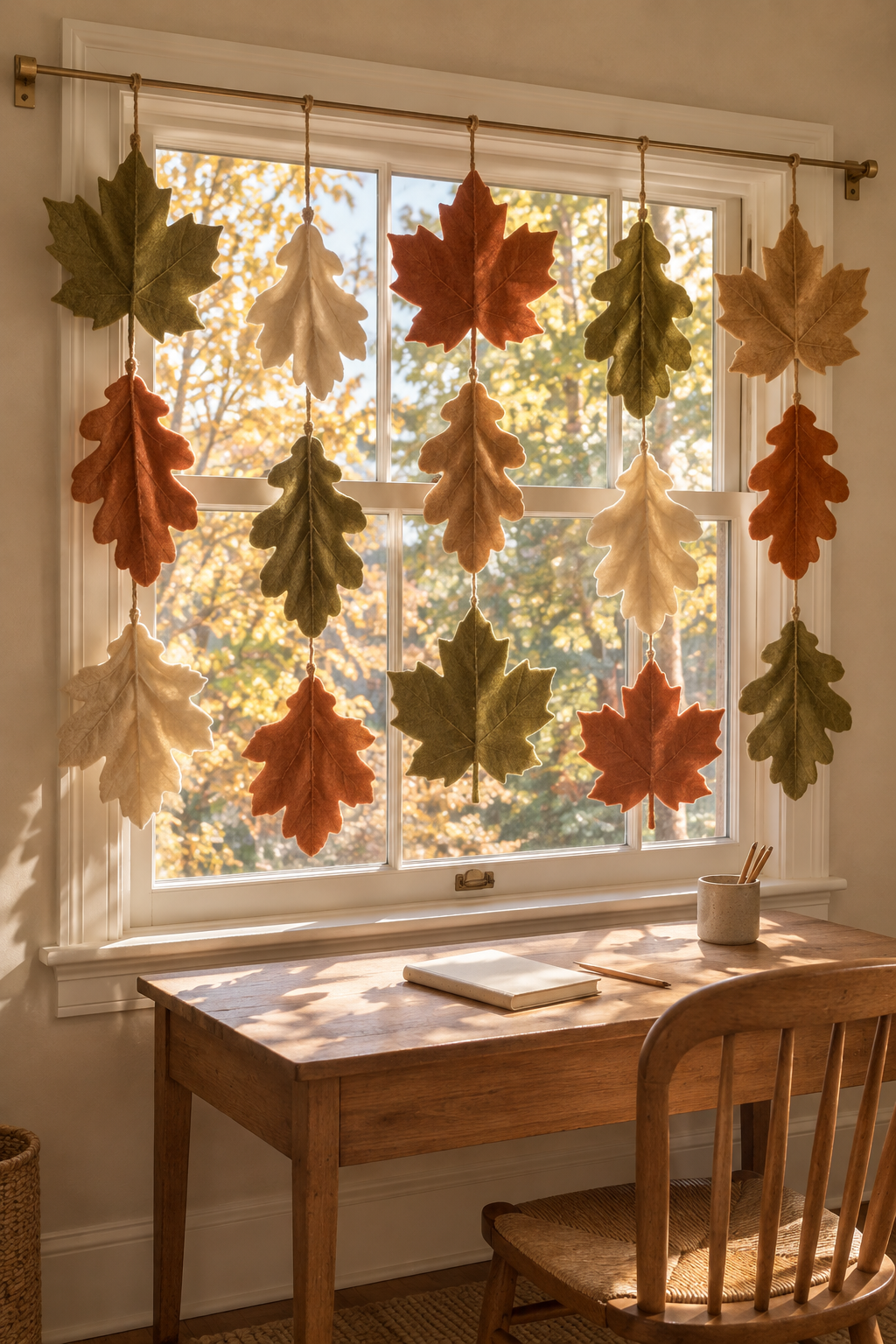
Oversized leaf shapes turn this workroom window into an autumn screen. Olive, cream, tan and terracotta leaves hang in separated strands across the glass, while morning light reaches the writing desk through the gaps. A slim rod above the window gives the display a clear starting line, with the lower leaves stopping short of the desktop.
The idea suits a room where a conventional fall arrangement would take up useful space. Here, the decoration lives on the window plane rather than on the desk. To adapt it, keep the leaves large enough to read as shapes, give the strands room to move aside, and let the window’s everyday function guide the layout.
What Makes This Look Work
Open spaces become part of the curtain
The leaf strands cover only portions of the glass. Bright outdoor foliage remains visible between them, so the display filters the view without becoming a solid textile panel. Those open areas also separate one leaf silhouette from the next.
The window divisions provide a quiet background rhythm. The hanging shapes do not need to align exactly with every pane, but their spacing makes the whole window feel intentionally dressed rather than randomly dotted with decorations.
Broad leaves have a soft textile surface
Maple-like points and rounded oak-like lobes give the screen varied outlines. The matte, felt-like surfaces catch light along their edges, with shallow ridges adding some depth. Each silhouette stays readable even where a tree outside supplies a busy background.
Mixing leaf shapes also changes the amount of glass each strand covers. A broad pointed leaf makes a stronger interruption than a narrow lobed one, so their placement matters as much as the chosen colors.
The palette connects indoors and out
The muted leaf colors sit comfortably beside the warm wood desk and the autumn view. Cream leaves brighten the darker strands, while olive keeps the arrangement from becoming entirely orange and brown.
Below the screen, a notebook, pencil and small cup leave most of the desk available. The room still reads as a place to work, with the window supplying the seasonal decoration instead of requiring another display surface.
Key Pieces to Recreate the Look
Oversized felt leaf shapes
Choose broad, recognizable silhouettes in a small set of muted autumn colors. The leaves should hold their outlines when suspended, with a soft surface that distinguishes them from paper cutouts or real dried foliage.
A slim removable rod
A rod slightly wider than the window gives the strands a support line and room to gather at a side. Use a removable mounting system suitable for the actual wall or trim, positioned away from moving window parts.
Neutral hanging cord
Tan cord visibly links the leaves into separate strands. Select a cord that supports the shapes without becoming the dominant pattern, and use adjustable loops when you want to change their spacing.
A narrow writing desk
A compact wood desk keeps the foreground useful and lets the window remain prominent. An existing table can serve the same purpose if its height and depth work comfortably with your chair and window access.
A plain desktop cup
A small neutral vessel gathers pencils without introducing another decorative theme. Choose a stable shape with a simple finish, keeping it below the hanging leaves so the screen remains unobstructed.
A quiet notebook or desk pad
A cream or neutral notebook repeats the lightest leaf color at desk height. Reuse everyday stationery rather than buying a display prop, and leave enough surface for the work you normally do here.
How to Style It at Home
Work around the opening mechanism
Check how your window opens before installing the rod. Mount it on a stationary surface beyond the moving sections, using fittings appropriate to the surface and total load. Leave latches and handles reachable, and check that the leaves can move aside without tangling.
Test the complete opening motion with a temporary strand before filling the window. A sash window, casement and sliding window require different clearances. The pictured arrangement suggests a removable screen, but it does not establish how every real window should be fitted.
Space the strands from a seated position
Sit at the desk and decide which parts of the view you want to keep open. Begin with widely separated strands, then shift individual leaves to avoid covering the same area at every height. A screen can feel dense from the chair even when it looks airy from across the room.
Let the bottom edge follow the leaf shapes rather than trimming all strands to one rigid line. Keep that edge clear of the desktop and anything you regularly lift from it, including a laptop lid or a desk lamp if you use one.
Distribute colors without making rigid columns
Move the cream and darker leaves between strands so no single column becomes a solid stripe of one color. The picture’s changing sequence gives your eye several small stops across the window instead of one heavy cluster.
For a darker room, use more light-colored shapes and fewer total leaves. For a strong outdoor view, reserve the widest gaps for that view. These adjustments retain the seasonal screen while responding to the room rather than copying the photo mechanically.
Keep everyday work within reach
Arrange the cup and notebook after the hanging screen is settled. Keep loose cords out of the work area, and leave a route to the window for opening, cleaning and adjusting the strands.
If the desk already holds substantial equipment, simplify the leaf display instead of relocating essentials for a styled photograph. A few broad silhouettes across part of the window can still transform its appearance, especially when the desk below stays free of competing fall decorations.
Shop Similar Pieces
Check felt thickness and usable sheet area
Small craft squares may not accommodate the broad leaves this look needs. Compare the usable sheet dimensions with your intended silhouette, and check whether the material holds its shape without additional backing. Precut leaf garlands often use much smaller pieces.
Look at the rod’s attachment and removal method
Review the mounting requirements and surface limitations before choosing a finish. A removable claim does not guarantee compatibility with painted trim, and the rod needs enough usable width for the strands to gather without obstructing the window.
Choose cord by how it handles
A cord that forms bulky knots can distract from the soft leaf shapes. Compare flexibility, attachment needs and color with the chosen felt, and check whether the upper loops can move smoothly along the rod.
Size the desk for the actual task
Look beyond the warm wood finish to desktop depth, legroom and chair fit. A shallow decorative console may resemble the image but be uncomfortable for writing or computer work, so prioritize usable furniture over an exact visual match.
Final Styling Tip
Before cleaning the glass, slide the strands together and loosely contain them with a soft reusable tie. This keeps individual leaves from twisting into the cleaning area while preserving their spacing for when you spread them out again.