*This post may contain affiliate links for which I earn commissions.*
This image was created with AI to offer inspiration for decorating your own home.
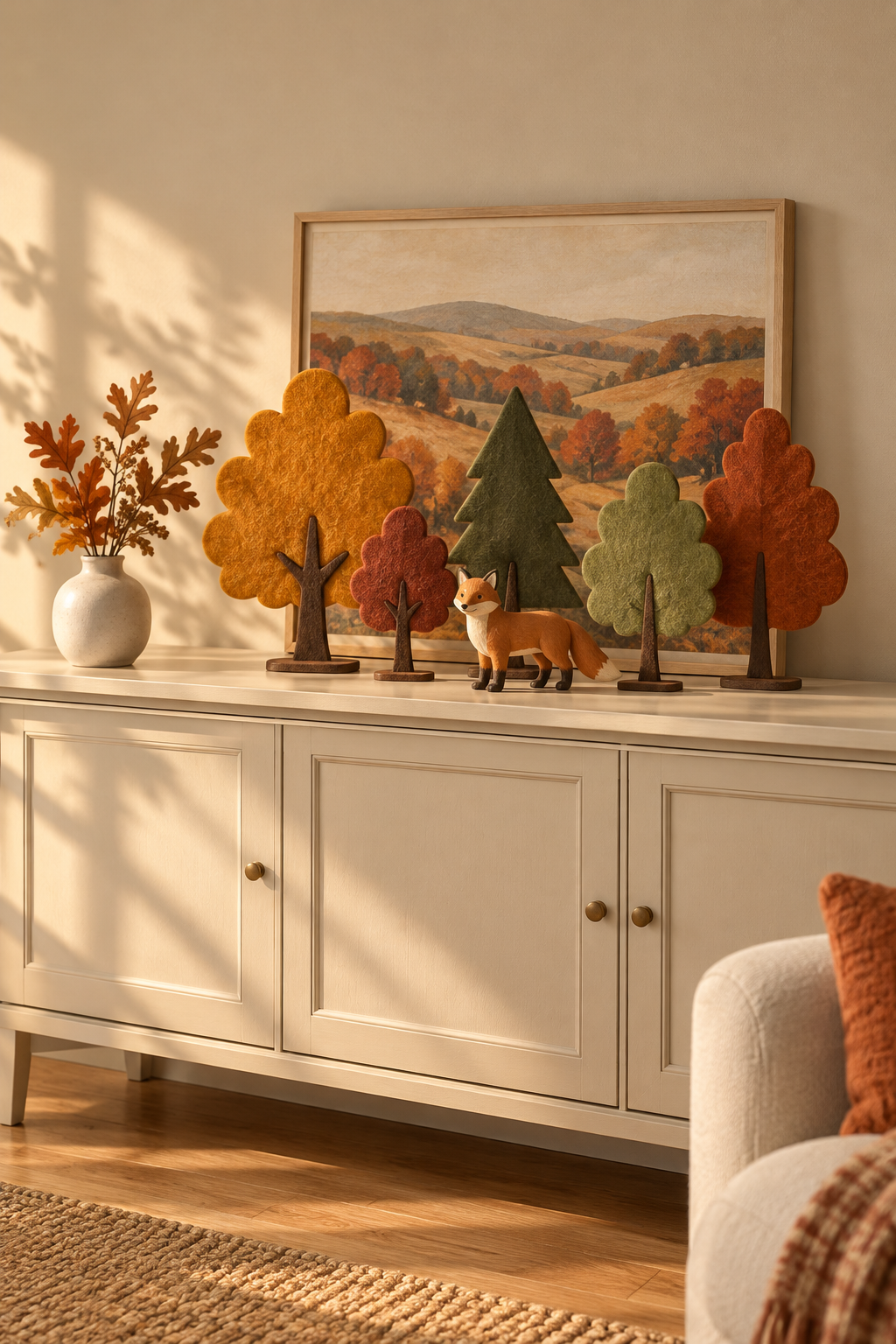
A little fox stands between soft-edged trees on this cream cabinet, with a painted autumn landscape behind the group. Ochre, russet, and muted green repeat across the foreground and the picture, giving the display the feeling of a woodland scene from a storybook.
The felt-like tree surfaces, small figurine, and leafy vase bring several textures together without covering the cabinet in loose decorations. This is an indoor styling idea built around a few recognizable shapes. It can suit a living-room credenza, a low shelf, or another stable surface where the scene can be enjoyed at close range.
What Makes This Look Work
The picture extends the forest
The landscape supplies distant hills and autumn trees behind the freestanding shapes. Its pale sky leaves a quiet area above the foreground, so the display has depth without requiring a complicated scenic backdrop. The frame also gives the group a clear boundary against the plain wall.
Different tree crowns keep the shapes readable
Rounded ochre and russet crowns sit alongside a pointed dark green tree. Their differing profiles make the woodland recognizable even though the forms are simplified. The visible trunks and flat bases help the trees read as standing decorations rather than a row of loose cutouts.
The fox gives the scene a small focal point
The fox sits in front of the taller trees, with its pale chest and dark feet visible. Its modest size makes the setting feel larger by comparison. A single animal also gives the eye somewhere to settle without turning the cabinet into a collection of unrelated figurines.
Key Pieces to Recreate the Look
Freestanding felt trees
Soft, matte tree shapes bring the illustration-like quality into the room. Look for finished standing decorations, or felt-covered tree forms, with visible trunks and secure bases rather than unsupported fabric shapes.
A small fox figurine
A standing fox in warm rust and cream connects naturally with the autumn palette. A simplified sculpted finish fits this scene better than a highly detailed wildlife model or a novelty figure with extra accessories.
A framed autumn landscape
Choose a picture with quiet hills, woodland colors, and enough open sky to sit behind the trees. A simple warm wood frame keeps the picture connected to the brown trunks and bases.
A low cabinet or credenza
A broad, stable top offers room for staggered pieces and the framed backdrop. The cream finish in the image lightens the scene, but warm wood furniture can support the same autumn colors.
A rounded pale vase
The vase at the left balances the scenic group with one curved, simple form. Choose an opening that can hold a few branches without requiring a large bunch to keep them upright.
Muted autumn foliage
Oak-like leaves add a more natural silhouette beside the simplified trees. Sparse branches in warm brown and ochre keep this accent related to the forest instead of introducing a separate floral arrangement.
How to Style It at Home
Let the background set the height
Place the framed picture first and decide how it will be supported. If it is designed for tabletop display, use its stand; otherwise use suitable secure mounting or support rather than relying on an unstable lean. Keep it clear of the cabinet’s front edge.
Position the tallest tree against a quieter part of the picture. Allow some landscape to remain visible above and around the tree crowns. If the foreground hides the entire picture, the art becomes an expensive backdrop that contributes little. A smaller group may be more effective than moving the frame higher and higher.
Stagger the trees within a shallow footprint
Start with the pointed tree near the rear, then move rounded forms forward and sideways. Leave gaps through which the trunks can be seen. Overlapping a little of one crown is useful; covering an entire smaller tree makes the display harder to understand.
Check the bases as you arrange them. Each should sit fully on the cabinet, without balancing on another stand or slipping beneath the frame. You can bring a small tree forward to give the scene depth while keeping the larger forms at the back. Do not force the group into a straight line simply because the cabinet edge is straight.
Give the fox its own clearing
Place the animal after the trees, where there is an open gap between the trunks. Turn it so its head and tail are both recognizable from the main viewing angle. A fox pushed directly against a matching russet crown can disappear into the background.
Look at the cabinet from the sofa or chair where you normally sit. If the figurine looks too small from there, move it forward before replacing it with a much larger piece. The goal is a visible focal point that still belongs within the scale of the woodland.
Keep the foliage separate from the felt
Use the vase as a distinct side accent rather than threading branches through every tree. A few stems can reach toward the picture, but they should not cover the fox or lean across the foreground bases.
If you choose fresh or dried branches, check for falling debris and protect the cabinet beneath the vessel. Artificial stems are an alternative when you want consistent placement throughout the season. Either way, leave space between the vase and the felt forms so the materials remain easy to distinguish and dust.
Shop Similar Pieces
Examine the support behind felt decorations
Listing photos may show trees propped for styling. Check whether each piece actually includes a base or stand, and whether the felt covers a firm internal form. Hanging ornaments and thin felt sheets will not behave like the freestanding trees in this image without additional construction.
Compare fox measurements with tree height
Read the full dimensions, including the tail, rather than choosing by a close-up product photo. Look for a stable standing pose and a finish intended for indoor display. A seated animal can work as an adaptation, but it will change the little clearing’s outline.
Find art with a quiet upper half
Compare the complete composition, including the portion likely to sit behind the trees. Busy foliage across every inch can compete with the foreground. Check whether the listing includes a frame and whether the pictured colors are part of the print rather than surrounding styling props.
Choose branches that suit the vase opening
Stem length and stiffness affect whether a small vessel can hold the arrangement. Look for bendable branches that can be adjusted to your available height. A large bundled garland is less useful than individual stems when you only need a light spray at one side.
Final Styling Tip
When dusting, lift each tree by its base or firm trunk instead of pulling on the felt crown. Keep a soft brush nearby for the textured surfaces so the display stays neat without flattening the material.