*This post may contain affiliate links for which I earn commissions.*
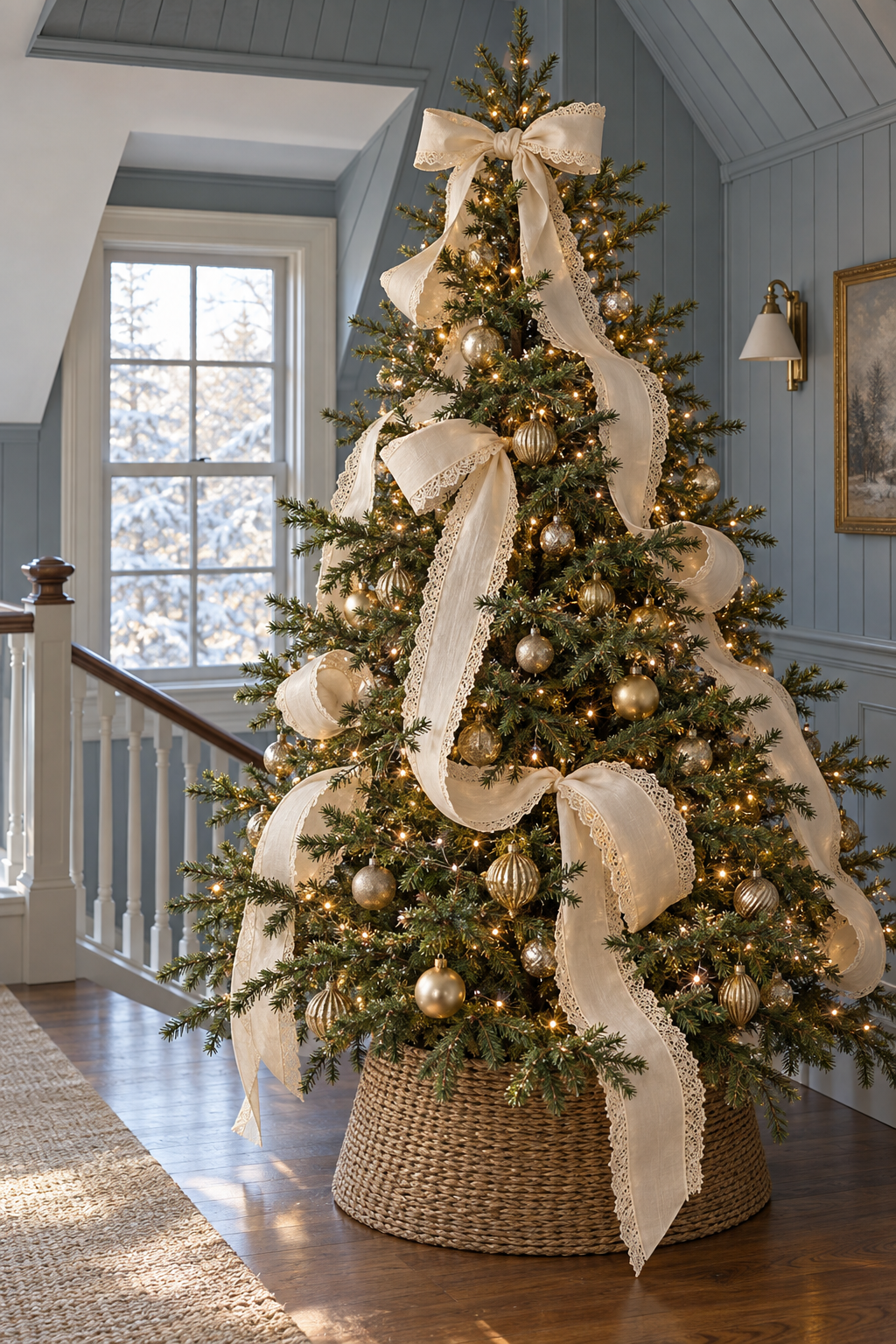
Broad ivory ribbons curl through an evergreen Christmas tree on a blue-gray stair landing. Lace borders soften the large loops, while gold-toned ornaments and small warm lights sit between the branches. A woven base cover completes the lower edge without a pile of gifts, giving the ribbons space to trail almost to the floor.
This image was created with AI to offer inspiration for your own home styling.
What Makes This Look Work
Wide ribbons become the main decoration
The ribbons are large enough to read from across the landing. Their broad surfaces create rounded folds, but the tree still shows through the gaps. Instead of wrapping everything in a tight spiral, the ribbon disappears into the greenery and emerges in another loose loop.
A bow high on the tree establishes the ivory treatment immediately. Lower bows and long tails continue the same idea at different heights, so the result feels connected without looking evenly striped.
Lace gives the oversized folds a softer edge
The narrow patterned border adds detail exactly where the ribbon curves toward the viewer. That makes the large shapes feel lighter and more delicate than plain stiff bands would. The lace remains a finishing detail, with the solid ivory ribbon providing most of the visible surface.
This is a useful balance for a sculptural tree: one feature can be oversized while its finishing details remain fine. Adding lace-covered ornaments everywhere would blur that distinction and make the branches harder to read.
Gold ornaments bridge the lights and the room
Rounded and ribbed gold-toned ornaments pick up the warmth of the lights. Their smaller scale gives the eye somewhere to rest between the broad ivory folds. Against the cool paneled wall, this restrained warm palette makes the tree stand out without introducing red, bright metallic colors or patterned wrapping paper.
Key Pieces to Recreate the Look
An evergreen tree with readable branch gaps
Select a tree whose branches can accommodate ribbon tucks without concealing every ornament. A moderately open silhouette gives the large loops room, especially in an upstairs space where the tree cannot spread indefinitely.
Broad ivory ribbon with lace edging
The most important qualities are enough width to form visible folds and enough flexibility to fall naturally. A ribbon with a fine lace border is the closest visual starting point; ivory fabric paired with compatible narrow lace trim is another option.
Small gold-toned ornaments
Mix a few compatible surface finishes, such as matte, lightly reflective and ribbed. Keep the shapes simple so they support the ribbon instead of adding a second elaborate theme.
Fine warm-white tree lights
Small light points leave the ornament and lace details readable. Choose a strand suitable for the tree and location, then distribute it through the greenery rather than draping a bright line across each ribbon fold.
A woven tree collar
A natural woven cover gives the base a compact finish. Look for a collar that accommodates the stand and allows access to any maintenance the tree requires, rather than assuming a decorative basket can replace a proper tree stand.
Soft ties for ribbon attachment
Flexible ties help anchor the ribbon where it enters the branches. Match the attachment to the tree and ribbon, and avoid fastening delicate lace edges directly where they could tear under tension.
How to Style It at Home
Choose the tree position with the staircase in mind
An upstairs landing needs a clear walking route and full access to the handrail. Position the tree so the widest branches and loose ribbon tails stay within its decorating zone. Check doors, stair approaches and the ceiling slope before deciding that the pictured scale will fit your home.
You do not need blue-gray paneling to use the idea. Against a plain white wall, the ivory ribbon may blend in more, so slightly warmer ornaments can help separate the tree from its background. In a darker room, the ribbon itself will provide most of the contrast.
Put the lights on before forming the loops
Arrange the light strand through the branches while the tree is otherwise undecorated. Look at it both in daylight and after the room becomes dimmer. Correct bright gaps or concentrated patches before adding fabric that might make the wiring harder to reach.
Follow the light manufacturer’s instructions and keep fabric positioned appropriately around the strand. Do not hide a tangled bundle of lights behind a large bow merely to make the front appear tidy.
Work downward with interrupted ribbon sections
Try a small sample section first to see how the ribbon bends. Form one generous loop, tuck the end into a sturdy branch area, then move lower rather than circling the tree in a fixed pattern. Shorter sections can create the appearance of a longer flowing path while being easier to handle.
Turn some folds outward and let others sit deeper among the needles. Step back after each section. If several loops line up like identical brackets, shift one attachment point or change the next fold’s depth. Leave green spaces between them instead of filling every gap with another bow.
Place ornaments where they will remain visible
Add the gold-toned pieces after the main ribbon paths are settled. The useful spaces are between folds, beneath projecting branches and in open pockets of greenery. An ornament tucked directly behind a broad loop contributes little to the finished view.
Check each hanging piece from the approach to the landing, not only from directly in front of the tree. Keep heavier ornaments on suitable branches and move any that pull a branch into an awkward downward angle. Finish the base last so its position does not interfere with adjusting the stand or light connection.
Shop Similar Pieces
Inspect the ribbon edges in close-up photos
Look for images that show both faces of the ribbon and the lace attachment. A narrow decorative strip photographed at close range can look much wider than it is, so confirm the listed width and supplied length before judging whether it can form substantial loops.
Compare ornament finishes as a group
Check whether a mixed set contains several warm gold finishes or introduces very bright silver and bronze pieces. A coherent small assortment is more useful for this tree than a large collection whose colors fight the ivory ribbon.
Check how the collar opens
An opening or sectional design can make placement around an assembled tree easier. Compare the collar’s internal dimensions with your stand, and check that it will not cover controls, sockets or watering access you need.
Select lights for readable sparkle
Use product information to compare bulb size, color temperature description, strand length and power arrangement. Avoid choosing lights solely from a heavily exposed promotional photo, where tiny bulbs may appear as a broad glowing haze.
Final Styling Tip
When storing the ribbon, loosely roll each section around a wide tube and place tissue beneath the lace edge. Keeping the border from being sharply folded will make it easier to reshape the large loops the following season.