*This post may contain affiliate links for which I earn commissions.*
This image was created with AI to offer inspiration for decorating your own home.
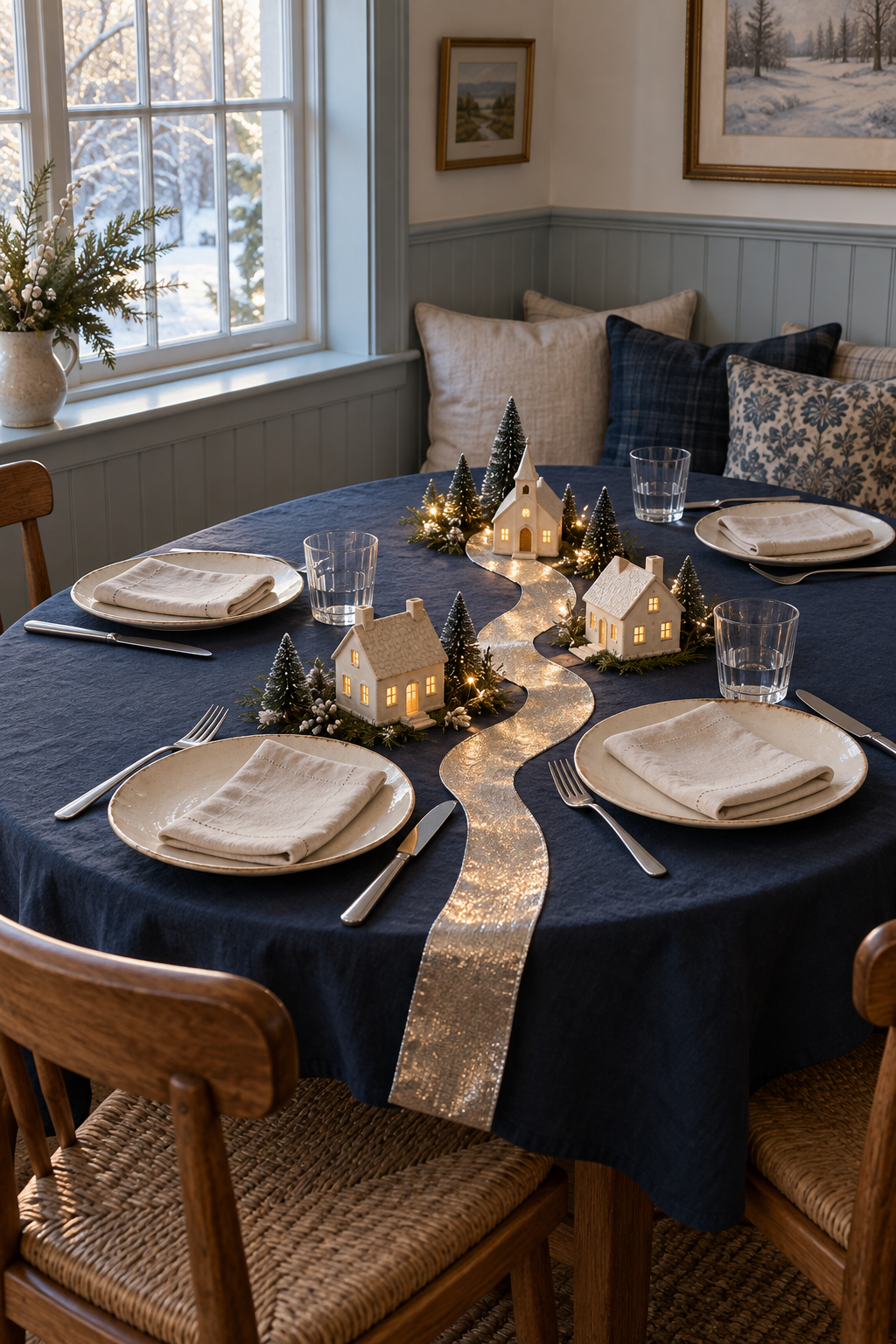
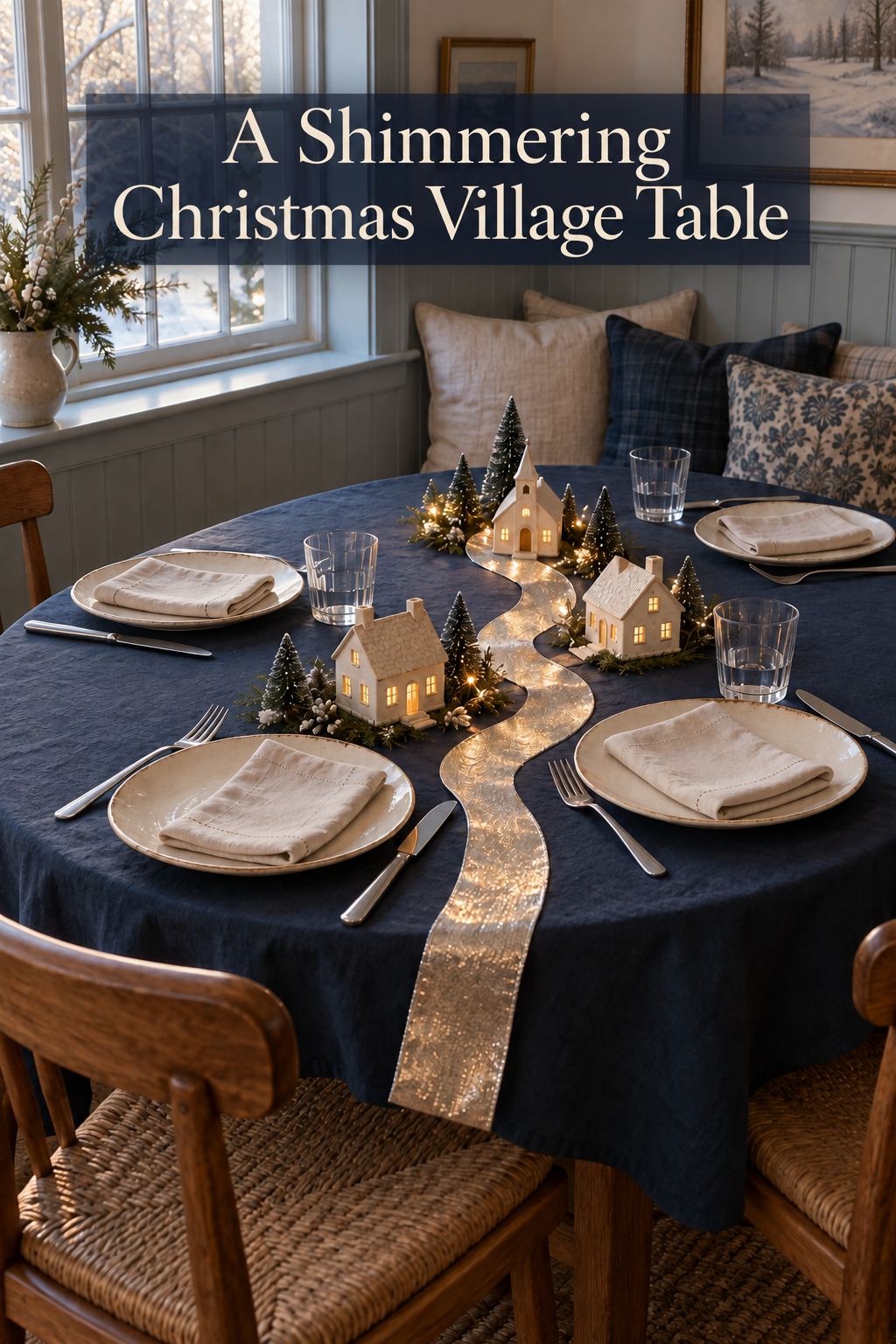
A silver ribbon winds between glowing little houses on this Christmas table, giving the centerpiece the feeling of a village street. Against a deep blue tablecloth, the pale buildings and cream place settings are easy to see without filling every inch of the surface.
The idea is especially appealing for a dining nook, where a small scene can feel complete without requiring a long table. You can adapt the route to your own tabletop and keep the dinnerware you already use. The important choices are the shape of the road, the proportions of the houses, and how comfortably everyone can eat around them.
What Makes This Look Work
The ribbon gives the houses a shared setting
Instead of standing in an unrelated row, the buildings sit beside a winding strip that connects them. Its bends suggest a route through the settlement. The little trees and greenery cluster near the houses, leaving the road visible enough to carry the story.
Deep blue makes the glow readable
The tablecloth provides a dark, quiet background for pale walls and illuminated windows. Cream napkins soften the contrast, while silver flatware picks up the ribbon’s reflective finish. There is no need to add another bright accent color to make the table feel festive.
The room continues the winter mood
Blue-gray paneling, upholstered bench seating, and winter landscape pictures support the table without competing with it. Daylight shows the texture of the cloth and the glittering road, while the small warm lights make the village feel inviting. The room gives this miniature scene a believable home setting.
Key Pieces to Recreate the Look
Small illuminated village houses
Pale houses with simple rooflines are the main decorations. Choose tabletop pieces that look comfortably smaller than the dinner plates rather than buildings sized for a floor display.
Wide silver decorative ribbon
A broad, softly reflective ribbon becomes the village road. A flexible fabric ribbon is easier to curve than a rigid metallic strip, and its surface should shimmer without shedding heavily onto the table.
A midnight-blue tablecloth
The blue cloth makes the pale scene stand out and ties the table to the bench cushions. A matte or lightly textured finish lets the road remain the main reflective surface.
Miniature evergreen trees
Dark model trees give the buildings a setting and break up the pale roof shapes. Use a few heights, keeping the tallest trees within the centerpiece rather than beside a guest’s glass.
Fine-wire battery lights
Small warm light points appear around the village clusters. A discreet strand can support unlit buildings or add a little glow around the trees without introducing large cords across the dining surface.
Cream plates and napkins
Simple pale dinnerware and folded napkins give each seat a clear boundary. Existing cream or off-white pieces can work well; elaborate plate stacks would take space away from the scene.
How to Style It at Home
Lay out the seats before the street
Set out the actual plates, flatware, and glasses you will use, then pull up the chairs. This establishes the available center space more accurately than measuring an empty table. Check the place nearest the rounded end too, since its usable width may differ from the side seats.
Leave enough room for hands and forearms beside each plate. If the centerpiece fits only when the glasses sit awkwardly far away, reduce the village footprint. The image shows a decorated dining table, but your own menu may also require serving dishes. Plan to serve larger dishes elsewhere if the central scene uses that space.
Build gentle curves with loose ribbon
Place the ribbon down the center and ease it into broad bends. Avoid sharp folds that make it look like a zigzag. Leave a little slack along each curve so the inner edge can settle against the cloth.
Try the curve with the houses nearby before cutting the ribbon. A road that swings too close to a plate is difficult to rescue by adding more decorations. On a smaller table, one shallow bend may tell the same story as several turns. Trim the ends so they stop clear of diners’ laps and cannot be pulled accidentally.
Arrange doorways around the bends
Start with the most distinctive building, then place the others where the road changes direction. Turn some doorways slightly toward the route rather than making every facade parallel to the table edge. This helps the ribbon read as a street.
Add trees behind or beside the houses, with their bases fully resting on the table. Keep greenery sparse enough that guests can distinguish one cluster from the next. View the arrangement from every seat and move any building that blocks a comfortable view of the person opposite.
Make the lighting easy to reach
Put battery packs where you can operate them without lifting an entire cluster. Trace the wire close to the buildings and trees rather than stretching it across a place setting. Conceal only what can be hidden loosely; do not trap controls beneath unstable pieces.
Switch on the lights in the room conditions you expect during dinner. In daylight, the pale houses and ribbon should still form a readable scene. At night, reduce extra light strands if bright points overwhelm the windows. Battery lighting keeps this particular fabric-heavy arrangement free of candle flames.
Shop Similar Pieces
Check village dimensions as a group
Compare the height and footprint of every building included in a set, not just the largest piece shown in the listing photo. Look for accessible switches and note whether each house needs its own batteries. A small coordinated group is easier to fit between plates than a collection bought one building at a time.
Choose ribbon that will lie down
Check width, edge construction, and close-up photos of the weave. Stiff wired ribbon may require shaping to sit flat, while loosely woven mesh may reveal too much blue to resemble a continuous road. Favor a finish with attached metallic threads or well-fixed sparkle when it will be used beside food.
Compare blue cloth in ordinary light
Look beyond the styled product picture to customer photos and the stated care instructions. A glossy navy cloth can reflect lights as strongly as the ribbon, changing the effect. Choose a washable fabric and a size that suits the table with the chairs in place.
Look underneath the little trees
Stable flat bases matter more here than elaborate flocking. Compare base width with the available space beside a house and avoid fragile trees that lean easily. Some loose white flocking can fall onto nearby linen, so check how the finish is applied.
Final Styling Tip
Before dismantling the table, photograph the road from above and store the houses in that order. A quick layout reference makes it much easier to repeat the scene without starting from scratch next Christmas.