
*This post may contain affiliate links for which I earn commissions.*
This image was created with AI and is presented as decorating inspiration. A real installation needs an appropriate, load-rated support plan and clearances suited to the actual stairwell.
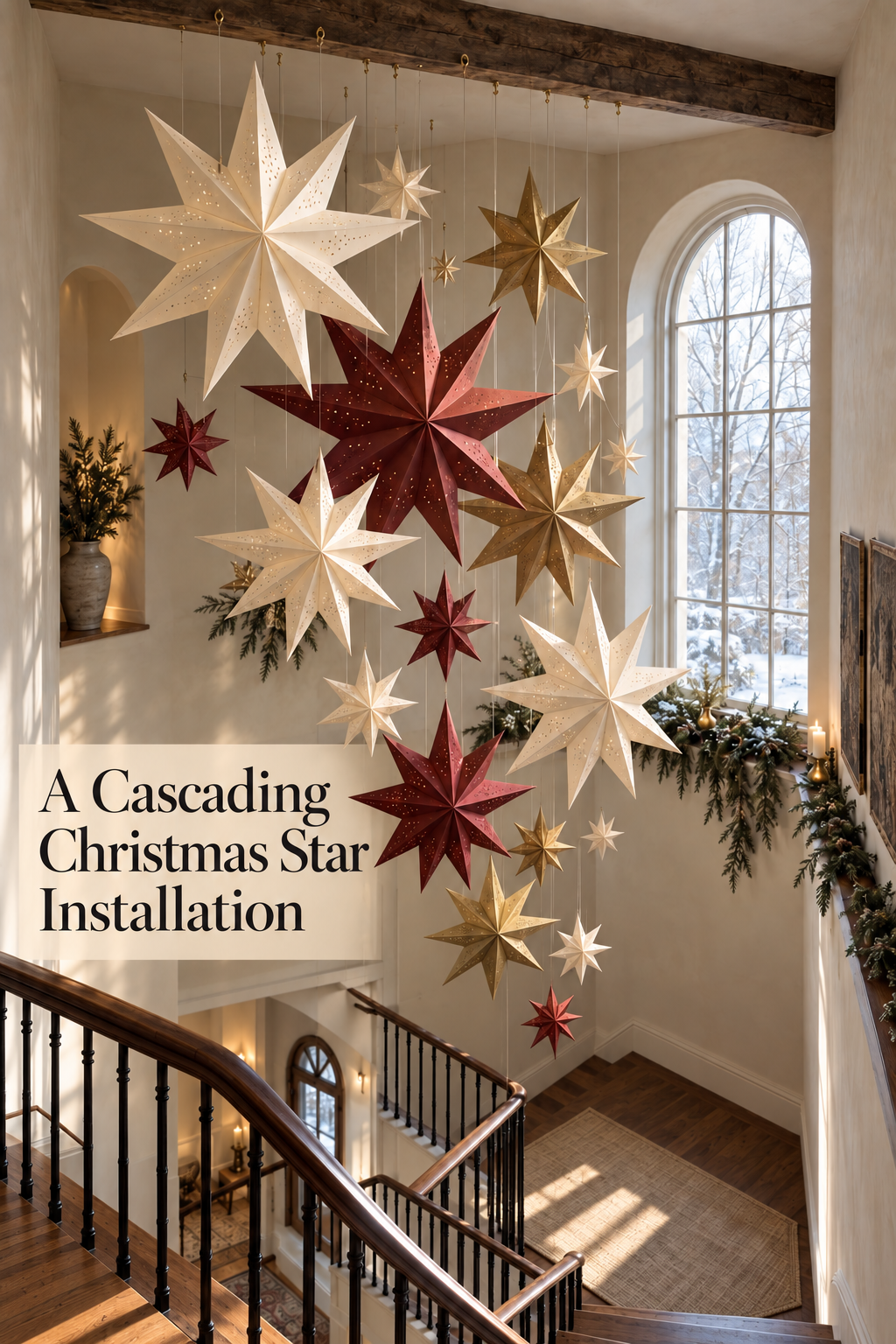
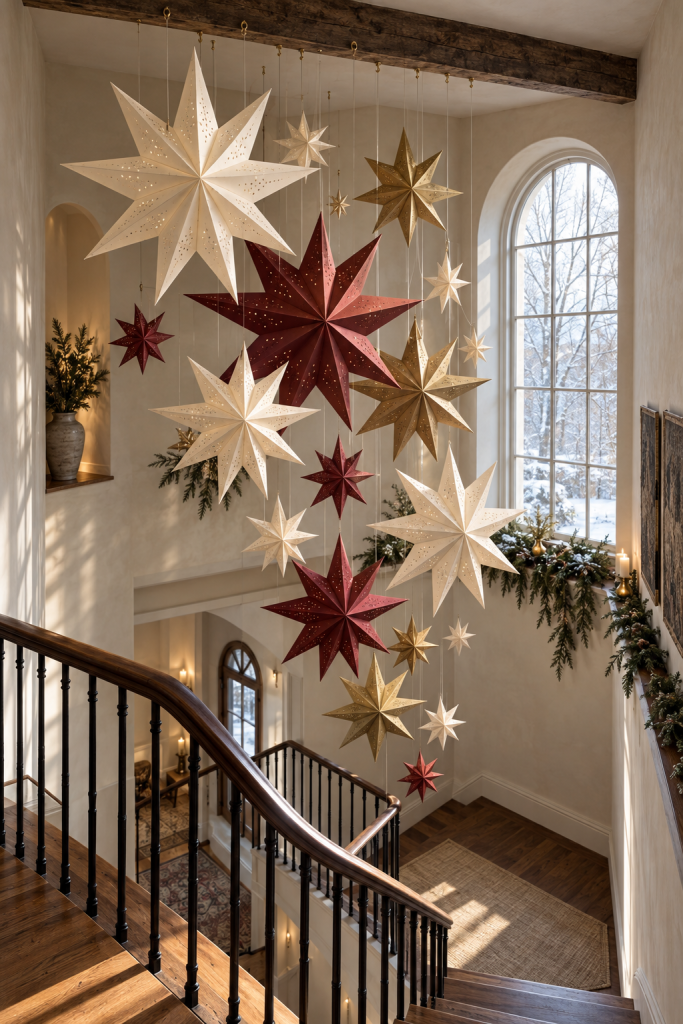
An open stairwell offers a different kind of Christmas decorating space: the air between floors. In this inspiration image, dimensional stars descend through that open volume, with an ivory star near the upper left and a deep red star near the center. Smaller stars carry the composition toward the lower landing. The arrangement reads as a single suspended installation rather than a collection of ornaments placed around the room.
What Makes This Look Work
A large star establishes the scale
The upper ivory star is noticeably larger than its neighbors. It gives the eye a starting point, while the broad burgundy star below it prevents the installation from feeling weighted toward only one side. Because the stars are spaced apart, their pointed silhouettes remain distinct even where several hanging lines cross the background. A small cluster of equally sized stars would lose the architectural impact of this arrangement.
Three colors make many shapes coherent
Creamy white, wine red and subdued gold repeat at different heights. The lighter stars pick up the pale plaster walls and winter window light; the red shapes supply depth against that soft backdrop. Gold is used sparingly, so it reads as a warm accent rather than another competing field. Subtle perforations and folded planes catch light differently, giving the repeated star form texture without a busy printed pattern.
The stairwell supplies a frame
A timber beam runs across the top of the scene, with small hanging points and fine vertical lines visible above the stars. The curved rail and tall arched window establish the height and depth of the space. Greenery sits along the wall-side ledge below the window, keeping the seasonal cue near the architecture while leaving the floating field of stars as the focal feature. The stars occupy the open well, away from the visible stair treads.
Key Pieces to Recreate the Look
Oversized dimensional paper stars
Choose lightweight stars with deep folded points and a strong silhouette. One or two large pieces should lead the display; matching them all in size would flatten the cascading effect.
Smaller coordinating stars
Mix a few medium and small stars around the anchors. Repeat the same general pointed form while changing scale and height, so the installation feels related without becoming a rigid grid.
Fine hanging line
A narrow line lets the stars remain the focus, yet it must suit each ornament’s actual weight. Its attachment should be secure and the line length measured for the intended drop.
Appropriate ceiling attachment hardware
The image shows hanging points near a beam, but a real ceiling or beam requires hardware selected for its construction and load. Use a suitable rated method, and ask a qualified installer when the substrate or access is uncertain.
Restrained evergreen greenery
A modest greenery treatment on a fixed ledge gives the pale stairwell a Christmas context. Keep it below the star field and away from the handrail or walking surface.
Battery operated accent lights
Small warm points of light appear along the ledge and lower level. If adding lights at home, use separate battery powered accents in stable locations rather than running loose cords across a stair route.
How to Style It at Home
Map the open space before choosing sizes
Look at the stairwell from both floors and identify the volume that does not overlap the usable stairs, landings, railings, doors or window operation. Mark a conservative lower boundary. A tall room can support a few dramatically large stars; a lower ceiling may need fewer pieces with more space between them. The principle is a visible cascade, not a fixed number of decorations.
Design the drop on paper
Sketch the attachment span at the top and place the largest shapes first. Give them different heights and avoid lining their centers up in a straight row. Add smaller stars to bridge the gaps. Check from the main viewing angle that each star has enough background around its points to read clearly. A diagonal rhythm can feel lively without requiring every line to differ by the same interval.
Match support to real conditions
Select lightweight decorations and verify the weight and mounting method before hanging anything overhead. Ceiling material, beam construction and access differ from home to home; the hooks in the AI image cannot certify a safe real installation. Keep connections inspectable, use hardware suitable for the substrate, and avoid placing ornaments where they can be reached from the steps or swing into the passage. Do not use the stair rail as an improvised overhead support.
Add color in deliberate pockets
Begin with pale stars, then place burgundy at two or three separated levels. Use gold as a smaller accent between them. View the arrangement in daylight and again under evening room lighting before adding more. If the center becomes visually dense, remove one mid-size piece instead of filling every empty spot. A clear view through the installation makes its unusual scale feel intentional.
Shop Similar Pieces
Compare large paper star construction
Look for dimensions measured tip to tip, a defined three-dimensional fold, a secure hanging point and manageable weight. Confirm whether a star is simply decorative or designed to hold a light; the image alone does not establish an internal light source.
Find smaller stars with related silhouettes
Choose a mix of sizes within the same visual family rather than buying identical sets in every color. Check how each star opens, closes and stores, especially if the display will be reused next season.
Choose line and attachment separately
Compare line strength, visibility and knot behavior, then match the attachment to the actual ceiling or beam. Product descriptions should state the intended substrate and load; a general adhesive hook is not a substitute for an assessed overhead mount.
Keep greenery secondary
For a ledge, compare the garland’s fullness and flexibility with the available depth. A narrow, controllable length is easier to keep clear of the handrail than a heavy, densely decorated swag.
Final Styling Tip
Before removing the display, label each line with its star position and packed length. Rehanging the same cascade next year then requires far less measuring and helps preserve the spacing that made it work.