
*This post may contain affiliate links for which I earn commissions.*
This inspiration image was created with AI.
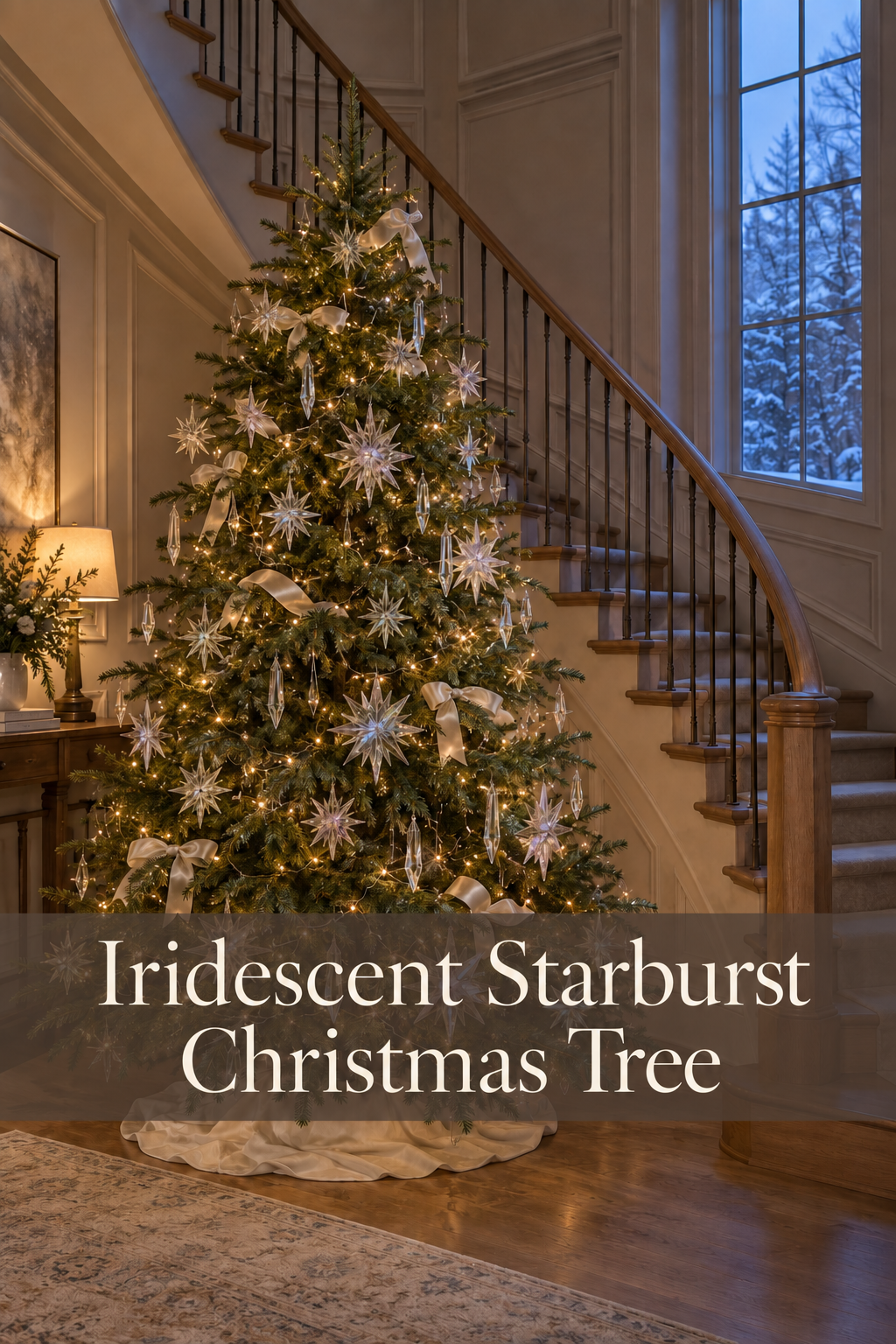
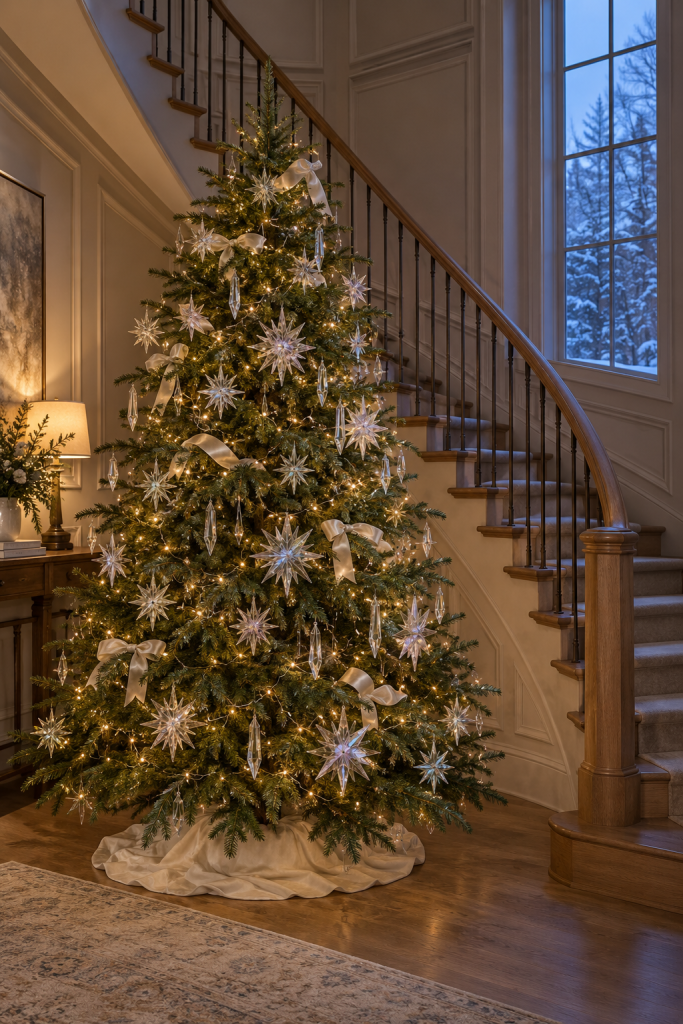
Clear, pointed starbursts cover this Christmas tree in a paneled stair hall. Long prism drops hang between them, and broad pearl-colored bows bring softer folds into the branches. Outside the tall window, a snowy landscape has turned blue; inside, fine warm lights reveal the evergreen needles. The curved oak handrail leads past the tree rather than disappearing behind a wall of decorations. It is a setting worth adapting for its ornament shapes and light, even without a staircase like this one.
Pointed Ornaments Against Soft Ribbon
The starbursts are the most distinctive pieces. Their projecting points separate them from familiar round baubles, while the clear surfaces let green branches remain visible behind them. Faint lilac reflections appear on several ornaments, but the tree does not depend on a strong purple or blue coating. That distinction matters when choosing substitutes: transparent, lightly iridescent pieces will behave differently from opaque glitter stars.
The narrow prism drops supply a second shape without competing with the stars. They hang vertically from branch tips and occupy spaces between the broader ornaments. Some catch only a small highlight, leaving darker branch pockets that give the tree depth. Keeping two main ornament families makes the arrangement easier to adapt than adding every celestial decoration available.
Pearl bows are distributed at different heights. Several have short tails, while a longer ribbon fold passes through the middle. Their loops sit among the needles rather than forming a tight spiral around the tree. The natural upper leader remains visible without a separate topper, and a loosely folded ivory skirt finishes the base.
Warm light also comes from the small table lamp at the left. Its presence explains why the oak and wall panels stay warm despite the blue window view. The image suggests an evening balance, not a requirement to turn every other room light off.
Six Categories for a Similar Christmas Tree
Translucent Starburst Ornaments
Look for multidirectional pointed shapes with clear or faintly iridescent surfaces. Compare the full width, including the points, because these ornaments need more open branch space than round balls of the same central size.
Clear Hanging Prism Drops
Long faceted drops repeat the shine in a narrower form. Favor manageable lengths and lightweight pieces with secure hanging holes or loops rather than heavy decorative prisms designed for another use.
Pearl or Ivory Ribbon
Broad ribbon provides the bows and occasional loose folds. A soft satin or understated pearl-sheen finish suits the rendering better than thick glitter mesh, and flexible material will be easier to tuck around branches.
Fine Warm Tree Lights
Small light points reveal both the ornaments and the inner needles. Choose a set rated for the intended indoor use, with enough lead length to reach a suitable outlet without trailing across the stair route.
An Ivory Textile Tree Skirt
The pale skirt gathers in soft folds beneath the lowest branches. Size it to cover the stand while staying inside the tree’s footprint, especially where the display sits beside a walking path.
A Natural Looking Evergreen
An irregular, layered outline keeps this tree from looking like a solid decorated cone. If using an artificial tree, compare the open spaces between branches as well as its total height and width; an existing tree can work with fewer ornaments.
Plan the Floor Space Before Hanging Decorations
Measure the available corner, including the widest branches, not just the stand. Keep the stair entrance, handrail and route through the hall usable. The rendering shows generous separation at the stair’s lower curve, but a real doorway swing or furniture edge could make that location unsuitable. Choose a different position before trying to force the tree into it.
Set up the stand according to its instructions and confirm the tree is stable. For a cut tree, use an appropriate water-holding stand, monitor its water and follow supplier guidance for freshness. Keep it away from heat sources. An artificial tree still needs its stated base and clearance; decorative fabric cannot compensate for an unstable stand.
Install lights before fragile ornaments so the wiring can follow branch structure. Inspect the set and follow its limits for connecting strands. Keep plugs and controllers accessible, and switch the lights off when leaving or going to bed. The small warm points in the inspiration should not be reproduced by overloading a single branch with wire.
Next, try a few starbursts at the upper, middle and lower levels. I would check their silhouettes from the stair entrance before filling the gaps, since a wide ornament can vanish when it faces sideways. Use secure loops and place heavier pieces nearer stronger branch sections rather than at unsupported tips.
Add prism drops where they can hang freely. They should not rest against a star point or press into the skirt. Work around the tree’s visible sides, varying depth slightly so every piece is not lined up on the outer edge. Leave the narrow top lighter than the broad lower branches.
Tie bows separately and fasten them securely at selected branch junctions. For a modest-height tree, my compromise would be smaller loops rather than narrow ribbon: that keeps the soft shape while reducing the amount of fabric hiding the needles. Add only a few longer folds if the gaps genuinely need them.
Buying the Shine and Shape Separately
Clear Stars with Readable Points
Compare close photographs that show the ornament’s side view and hanging attachment. I would reject a flat opaque snowflake as the main substitute here, even in the right color, because the projecting transparent points are what makes this tree distinctive.
Check the Length of Prism Drops
Read the total hanging length, including the connector, so a drop fits between your branch tiers. Acrylic may offer a lighter adaptation, while glass requires more careful handling and support.
Ribbon That Holds a Gentle Loop
Look for ivory or pearl-toned fabric with enough flexibility to bend without sharp creases. Wired edges can help shape a bow, but the actual finish should remain subdued under the room’s lighting.
Choose Lights for the Actual Tree
Use the product’s stated coverage and electrical instructions instead of estimating solely from a listing photograph. A dark wire may blend into green needles more easily, but safety and compatibility come first.
A Small Detail for Taking the Tree Down
Keep a separate shallow tray for pointed starbursts while undecorating. Lay each ornament flat before packing it so projecting tips do not hook the next hanging loop and pull another fragile piece off a branch.