
*This post may contain affiliate links for which I earn commissions.*
This image was created with AI and is presented as decorating inspiration.
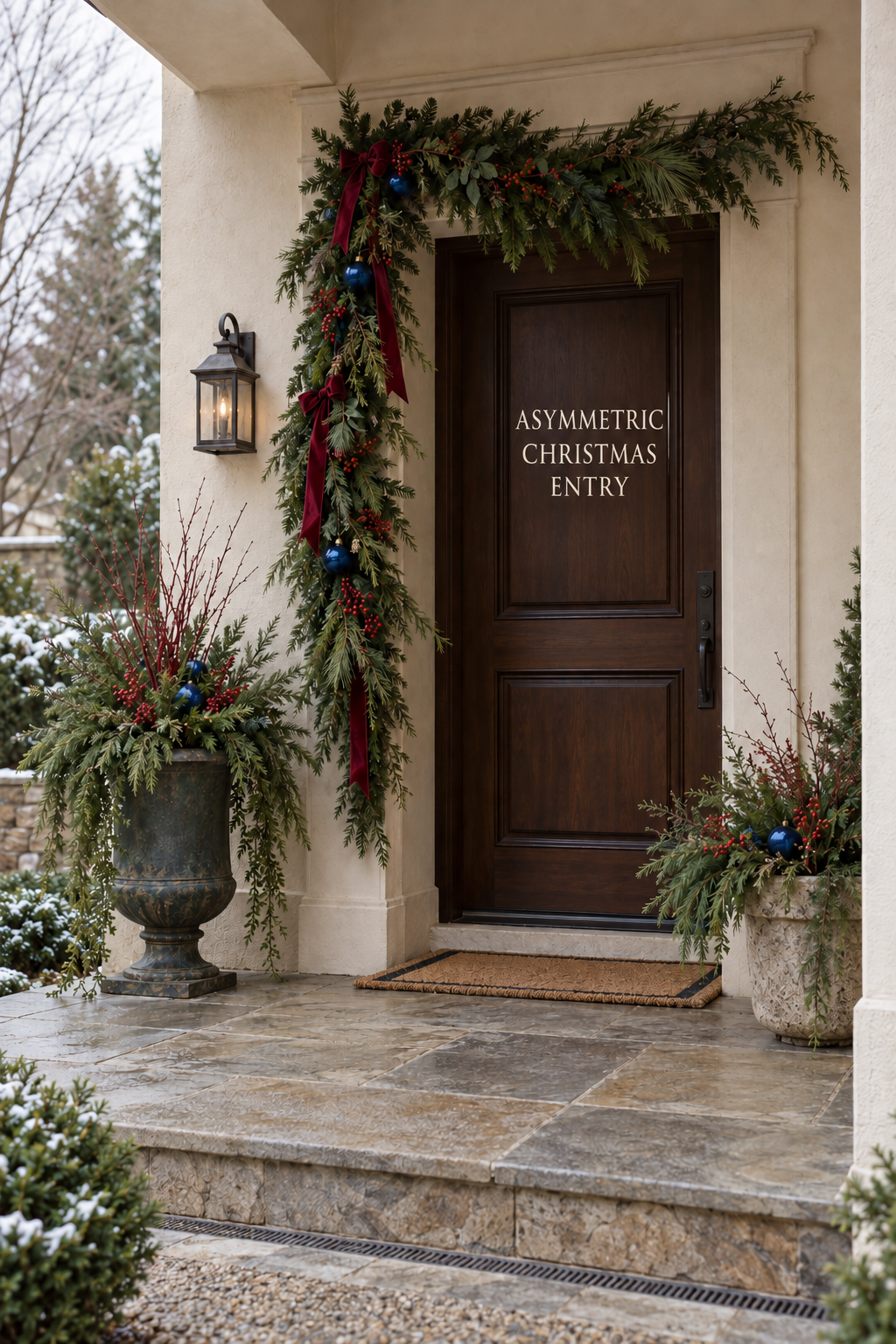
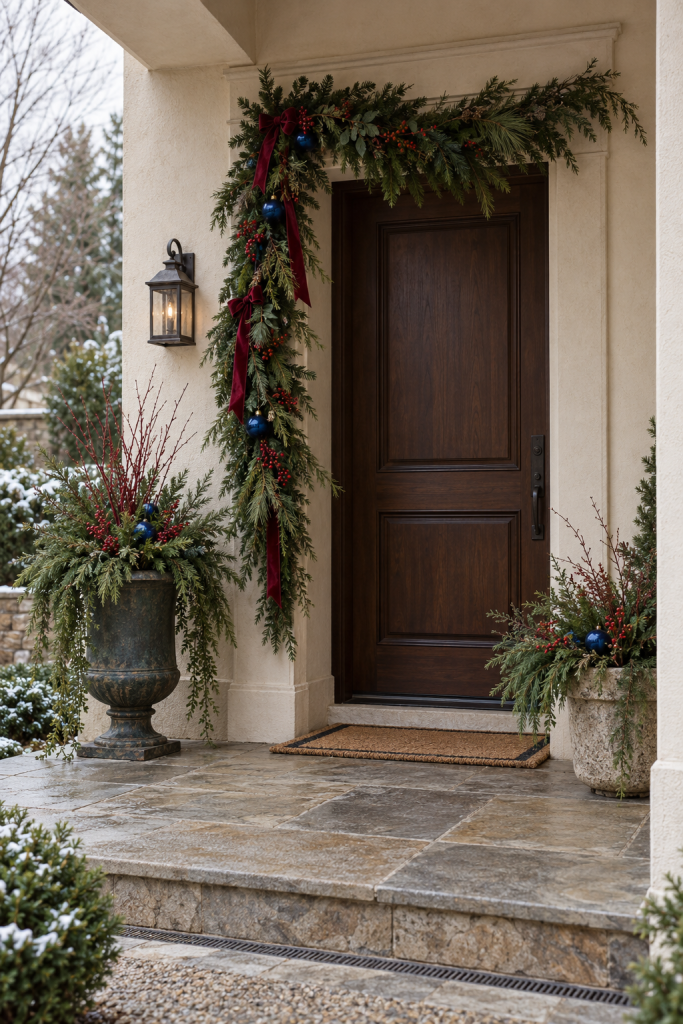
The dark door in this inspiration image needs no wreath. Greenery runs across its upper frame and down the left side, with burgundy ribbons and a few cobalt ornaments tucked into the branches. Two unlike planters bring the color down to the landing: a taller, dark urn on the left and a lower pale vessel on the right. The welcome mat and clear space directly in front of the door keep the decorated entrance usable.
What Makes This Look Work
The garland follows the building rather than the door
The greenery traces the doorway’s top and one side, leaving the wood panels and handle visible. Its left descent makes the entrance deliberately uneven without seeming lopsided because the large urn below continues the same vertical line. A similar treatment is most convincing when the existing surround offers secure, appropriate attachment points. Do not assume that the hooks or connections implied in an AI image describe a real installation method.
One accent color travels through three zones
The blue ornaments appear sparsely in the upper garland and in the planters. Burgundy ribbon and small red accents occupy more of the greenery. Repeating cobalt just enough to connect the levels gives this fairly traditional evergreen arrangement an unexpected color note. If you cannot find outdoor-suitable blue accents, preserve the principle with another restrained contrasting color rather than overfilling the garland.
Unequal planters balance an unequal frame
The left planter is taller and visually dark, while the right is lower and lighter. Both hold winter branches and greenery, so they belong together despite different shapes. Their size difference supports the one-sided garland instead of trying to impose symmetry. There is still a central landing to stand on while unlocking and opening the door, which should remain the priority in a real entrance.
Key Pieces to Recreate the Look
A flexible evergreen garland
The main strand needs to turn across a top corner and descend down one side without forming a rigid straight bar. Choose a realistic scale for the actual doorway and a form suited to its exposure. A mix of evergreen textures can be added in small secured bunches if the base looks too uniform.
Burgundy or wine-colored ribbon
Soft deep-red bows mark the left upper corner and vertical run. An outdoor-appropriate ribbon with enough body to hold a loose bow will read better from the path than thin narrow streamers. Keep tails away from the latch and walking surface.
A few deep blue ornaments
The cool, round accents break up the greenery. Choose pieces and attachment methods intended for the conditions at your entry, and secure each one individually. A small number is enough; the blue works because it is scattered rather than packed into one conspicuous cluster.
A tall dark planter and a lower pale one
The vessels establish different heights on opposite sides of the door. Check their outdoor suitability, stable bases and usable planting space before choosing finishes. Two identical planters would create a more formal entry, but would change this composition’s asymmetrical character.
Evergreen and twig-like planter fill
Both containers combine broad, drooping greenery with upright stems and small red accents. Use stems that remain supported inside the container instead of balancing long branches on its rim. If plants or cut foliage are used, choose care and weather practices appropriate to the actual species and climate.
A plain textured doormat
The mat gives a clear arrival point against the stone landing. Its simple surface avoids a fourth color block or written message competing with the garland. Select one that fits the door swing and lies flat on the actual threshold.
How to Style It at Home
Check the swing and walking zone first
Open the door fully and mark the area needed for a person, packages and any handrail or adjacent step. Place the planters outside that zone, then check their positions from the path. The pictured containers sit to the sides, not in the middle of the threshold. Even a beautiful urn is misplaced if it forces guests to step around it at the top of a stair.
Map the one-sided greenery route
Decide where the garland begins, turns and ends before attaching ornament accents. Follow the installation instructions for suitable hardware and the actual wall or trim surface; use secure support appropriate to the garland’s weight and exposure. Allow the greenery to drape naturally at the upper corner, but keep it away from the door leaf, latch, light fixture and any opening window. On a very narrow entry, shorten the side drop rather than pushing a thick strand into the walking space.
Build the planters from their structure outward
Start with the tallest upright branches, then add evergreen mass lower around them. Step back before inserting red or blue accents. The dark urn already has substantial presence, so the pale planter can be broader but shorter. Check that each arrangement stays in its vessel and does not lean toward the door. The image shows a sheltered recess, but real wind and rain may demand a simpler, more firmly secured arrangement.
Add color only after the green outline is settled
Place ribbon near the garland’s turn and one lower point, then distribute a few blue ornaments between greenery and planters. Look from the approach rather than from directly beside the door: the repeated blue should be perceptible without becoming a polka-dot pattern. Remove an accent if two pieces nearly touch or one sits where a sleeve could catch it.
Review it in ordinary daylight
This scene relies on overcast light, so the dark door gives pale stone, ribbon and ornaments clear contrast. Test your arrangement on a cloudy day and at dusk under the entrance’s existing lighting. If the deep ribbon disappears against a dark wall, shift it slightly onto greener foliage instead of adding more decorations. Confirm that the mat, planters and doorway remain easy to maintain through the season.
Shop Similar Pieces
Compare garland flexibility and length
Check the full route across the top and down one side of your own surround, including allowance for a natural curve. Compare construction and intended exposure, not just fullness in a product photo. A heavy, rigid strand may be difficult to secure along a narrow frame.
Look for ribbon that holds a loose bow
Choose a wine or cranberry tone that stays distinct from your door finish. Check width, edge construction and care directions for your sheltered or exposed location; a soft indoor ribbon may not suit an uncovered porch.
Assess blue accents for attachment and exposure
Look for a deep blue finish and a secure hanging point. Compare size against the garland’s branch scale and the planter fill. Product guidance on outdoor use matters more than an exact shade match to the AI image.
Choose planters for stability as well as shape
Compare the base footprint, usable interior, drainage and material guidance for your climate. The two vessels may differ in color and height, but both should work with the size of the arrangements and the available landing space.
Check mat clearance under the door
Measure the gap beneath your real door and the available level landing before buying a thick mat. A mat that curls or catches during opening undermines the clear-threshold effect of the whole composition.
Final Styling Tip
After a windy or rainy day, inspect the lowest garland end and the planter branches from the path. Those are the points most likely to shift into the passage, and a quick adjustment keeps the entry usable.