
*This post may contain affiliate links for which I earn commissions.*
This inspiration image was created with AI.
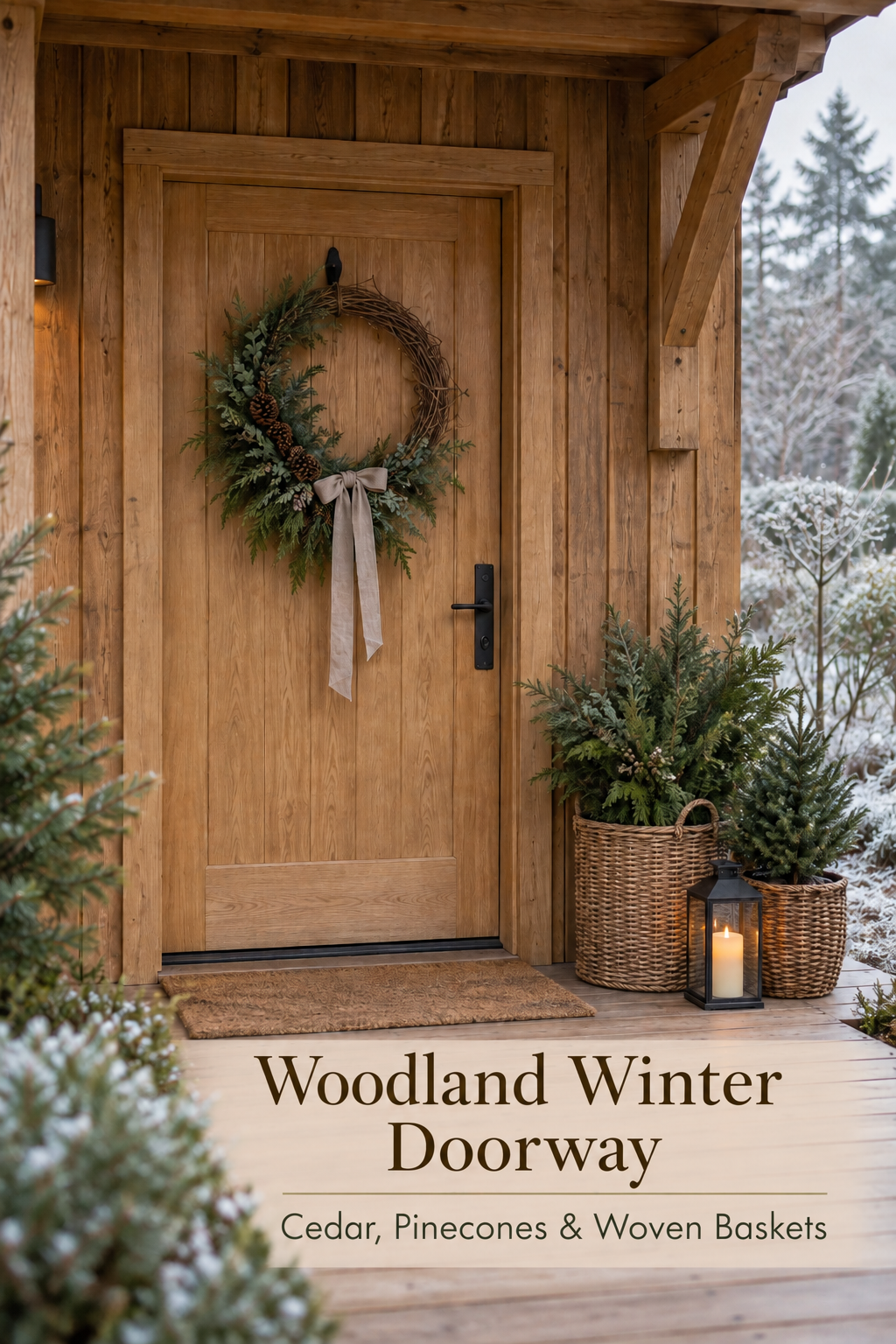
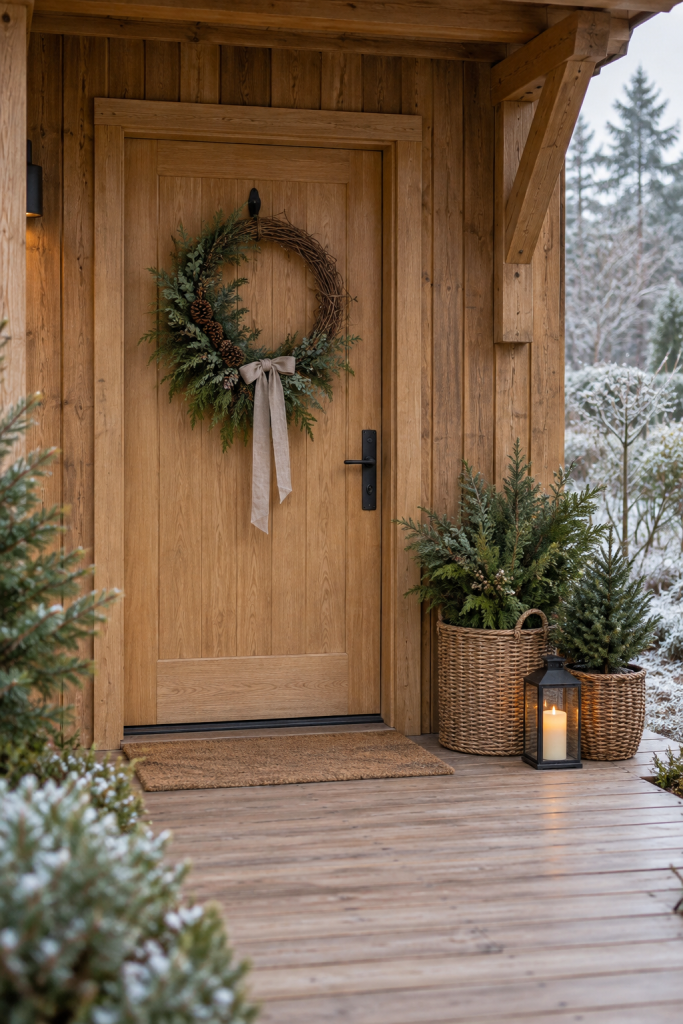
Honey-colored timber gives this winter doorway a warm background before any decorations are added. An open twig wreath carries cedar-like evergreen sprays, pinecones and a soft flax bow. Two woven baskets gather more foliage to the right of the door, with a small black lantern in front. The central porch boards remain clear.
The arrangement suggests a woodland entrance through familiar materials rather than an abundance of seasonal ornaments. Its strongest feature is the combination of a light door decoration and a compact floor group, each with a distinct place in the entrance.
How the Door and Baskets Share the Setting
An Exposed Wreath Base Lets the Wood Show
Most of the wreath’s greenery sits on its left and lower sections, leaving part of the twig ring visible. That open area lets the door’s grain remain part of the composition. Pinecones create little points of brown texture within the green, while the pale bow can be seen without needing a bright red accent.
The Baskets Repeat the House’s Natural Materials
The woven surfaces echo the timber’s warm color but introduce a smaller, more irregular pattern. Their differing heights allow foliage to sit at two levels. The taller basket holds loose sprays, while the smaller one contains a denser evergreen shape, so the pair reads as a group without appearing identical.
The Approach Has Its Own Empty Space
The doormat sits directly in front of the threshold, and the main walking area is free of lantern rows or scattered cones. A supported overhang frames the entrance. The snowy garden beyond strengthens the winter impression, but snow is not needed to reproduce the door treatment itself.
Main Pieces for This Woodland Entrance
An Open Twig Wreath
Choose a ring with enough exposed structure to support an uneven greenery arrangement. Its overall diameter should suit the door panel and leave the handle accessible, including when the wreath shifts slightly in a breeze.
Cedar-Like Evergreen Sprays
Airy, branching foliage gives the wreath and baskets their soft outlines. Real cut greenery or suitable faux stems can provide that appearance; their care and exposure limits differ, so select them for the actual sheltered location.
Natural Pinecone Accents
A few brown cones connect the evergreen treatment with the wood background. Small cones are easier to integrate into the wreath without covering its open shape; they should be attached securely rather than wedged loosely between twigs.
Flax or Oatmeal Ribbon
A narrow, soft bow introduces a pale textile accent. Choose ribbon that falls in relaxed tails and does not spread across the door handle, especially if the entrance is used frequently.
Woven Baskets with Inner Containers
Two baskets can create the graduated floor grouping. Use separate stable containers for plants or cut stems instead of treating an ordinary woven basket as a watertight planter, and check whether the basket itself is suitable for the location’s exposure.
A Black Lantern and Compatible LED Candle
The dark lantern adds a simple geometric outline against the foliage. A battery candle can provide a warm point of light, but outdoor or damp-location suitability must be established from the actual product’s instructions, not from its lantern shape.
A Plain Coir Doormat
A restrained mat leaves the wreath as the entrance’s main decorative feature. Choose one that fits the threshold and lets the door open without catching; a thick or curled edge can be impractical even if the color is right.
Plan the Porch Before Adding Greenery
Check the Door’s Full Movement
Open and close the door before deciding where baskets can stand. Include the handle’s reach, the area where someone pauses with bags, and the route from the approach to the threshold. Use that working space to set the floor group’s outer limit.
At a narrow entrance, I would keep only the taller basket and move the lantern beside it. The wreath already provides the woodland theme, so losing a second container is a reasonable trade for more room at the door.
Position the Wreath on Suitable Hardware
Use a hanger or hook appropriate to the door surface and the actual wreath’s weight. Follow its mounting instructions, and avoid assuming a temporary adhesive hook will work on rough wood or in cold weather. Let the lower greenery sit clear of the handle before securing the bow.
If adapting a plain twig ring, tuck compatible evergreen pieces in one direction and attach them with a suitable wreath-making method. Keep any wire ends contained behind the ring. Work toward a tapered outline rather than filling every gap.
Arrange the Containers from the Wall Outward
Set the taller basket near the wall, then place the smaller one slightly forward without extending into the route across the porch. Add foliage after the containers are positioned so that you can see whether stems project into shoulder or hand space.
For living plants, keep their drainage and care needs in mind and remove inner pots when watering if necessary. Do not let water sit inside an unsuitable outer basket or run across the walking surface.
Place Light Where It Can Be Maintained
Set the lantern on level boards and check how you will reach its battery compartment. It should not need to be dragged through stems whenever batteries are changed. The image’s glow is inspiration for a similar LED effect; it does not establish the candle’s real construction or weather rating.
I would choose a timer feature only after confirming that the lantern and candle suit the porch conditions. Convenient controls cannot compensate for a product intended solely for dry indoor display.
Buying Wreaths, Baskets and Lanterns for a Covered Porch
Look Beyond a Wreath’s Product Photo
Check whether its dimensions include the outer greenery or only the ring. An airy asymmetrical wreath can reach farther on one side than a circular photograph suggests. Compare the bow placement and attachment method, and favor a modest base that leaves space around the door hardware.
Ribbon with a Soft Fall
Review the ribbon’s width and whether it is wired. A heavily wired ribbon may produce a rigid bow rather than the narrow relaxed tails here. Confirm its exposure suitability if rain can reach the door, and choose an oatmeal tone that remains distinct from your timber or paint.
Baskets That Accommodate Your Pots
Measure the widest part of the inner pot and the basket opening, including any narrowing below the rim. Handles should not force the foliage outward into the path. Check intended use and maintenance guidance rather than assuming all wicker can stay outside through winter.
Lanterns with Appropriate Candle Clearance
Compare the lantern’s interior dimensions with the LED candle you intend to use. The candle should sit level and leave the door able to close. Verify the environmental limits of both pieces separately, since a metal enclosure does not automatically protect an indoor battery candle from moisture.
Final Styling Tip
After the first windy day, inspect the underside of the wreath for rubbing against the door. If needed, use a compatible protective buffer according to the door finish and hanger guidance before repeated movement leaves a mark.