
*This post may contain affiliate links for which I earn commissions.*
This image was created with AI. The following approach translates its visual rhythm into choices that can work on an actual tree.
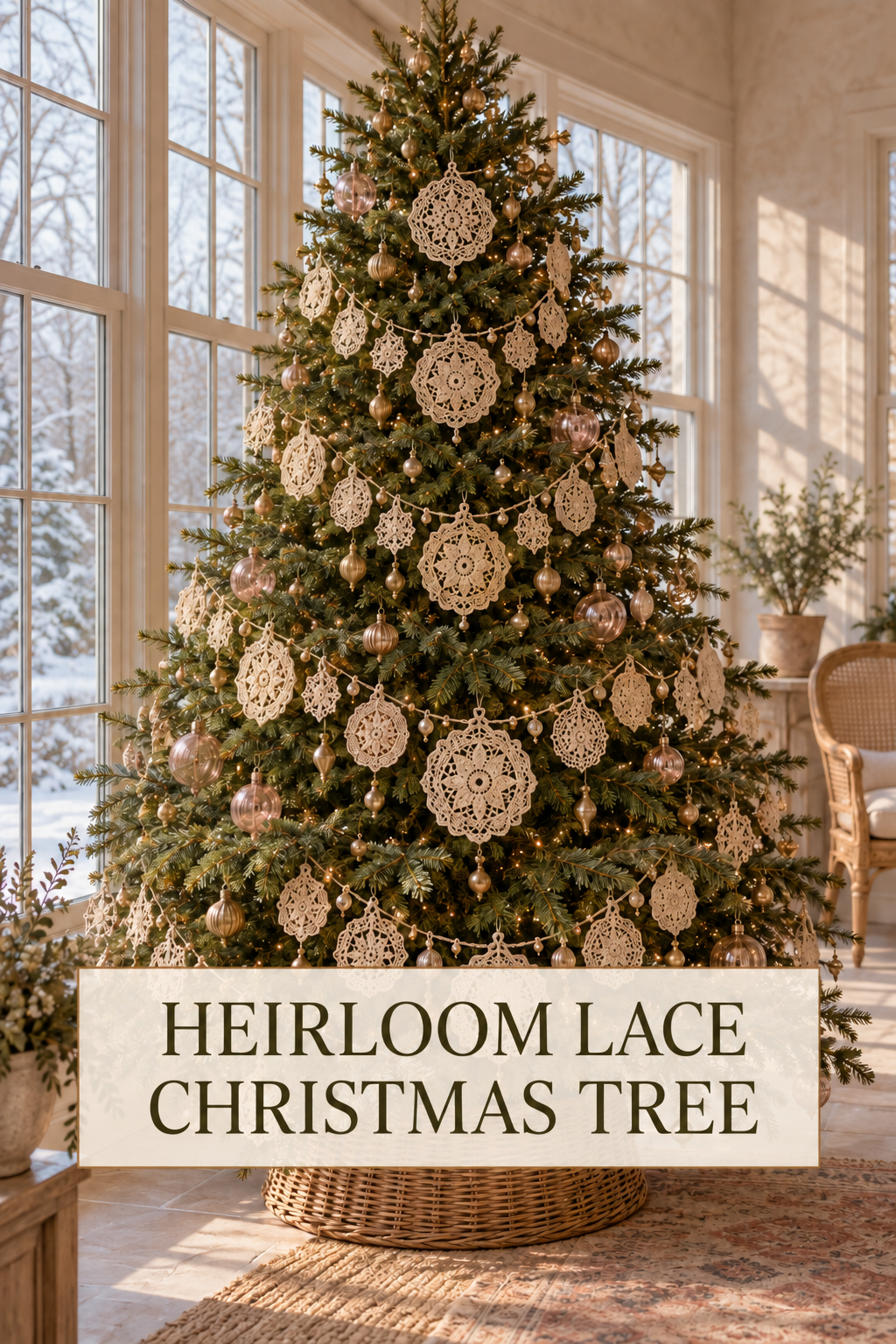
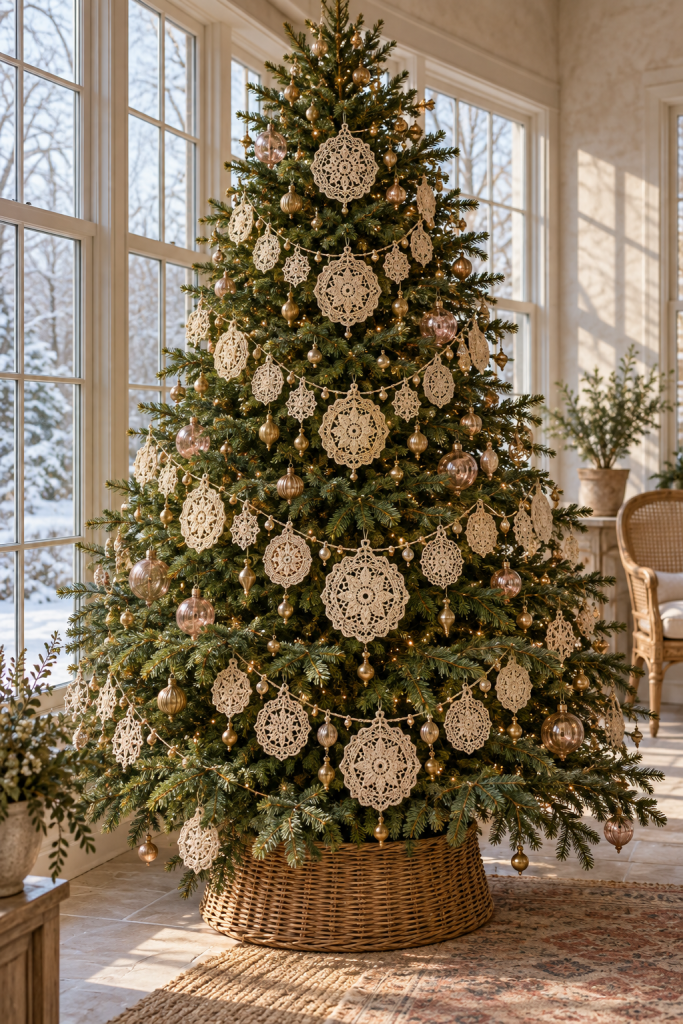
This Christmas tree gets its identity from repeated openwork medallions rather than a heavy ribbon treatment. Against the deep green branches, the ivory ornaments form a loose pattern from top to bottom. Small gold and blush-toned baubles catch the lights between them, and a woven collar settles the full tree into its bright window corner.
What Makes This Look Work
Openwork needs a dark background
The lace-like shapes are easy to see because the evergreen shows through their openings. If the same ornament were layered over a pale wall or another cream decoration, much of its detail would disappear. Hang the largest pieces on outer branches where their edges remain visible; tuck smaller pieces deeper for dimension.
The image suggests handmade lace, but exact provenance is less important than the open circular silhouette. Crocheted motifs, stiffened fabric lace or lightweight lace-look ornaments can all communicate the idea. Lay several candidates against an evergreen branch before committing to a full set. A motif that looks striking against white packaging may disappear once it is surrounded by lights and pale baubles. A little tonal variation among ivory pieces can feel collected, as long as the round openwork remains the common language.
Repeat the circle at changing sizes
Large round medallions punctuate the middle and lower branches, while smaller versions bridge the gaps. Their repetition gives the tree a recognizable motif without making every branch identical. Avoid a rigid spiral or perfect grid. Follow the natural branch tiers, stepping back frequently to compare empty and full areas.
Begin by dividing the visible front of the tree into broad height zones. Place large medallions in the middle and lower zones, with one higher up to carry the motif toward the top. Then rotate around the tree and check the sides, especially if it stands in a corner with two exposed views. Avoid putting every largest piece on the same horizontal tier. If a motif turns edge-on, adjust its hanger or move it to a branch facing the room rather than filling the gap with more ornaments.
Use shine as a supporting note
The smooth baubles and warm points of light contrast with the matte, intricate ornament pattern. They are present throughout the tree but do not replace the medallions as the main idea. A restrained metallic family is enough. Too many highly reflective colors would compete with the delicate outlines.
An ornament family can look plentiful without requiring every piece to match. Use fewer large anchors than medium pieces, and let small motifs bridge the irregular spaces created by real branches. The metallic baubles can sit slightly deeper, where their reflections add depth without obscuring the lace. If the tree is prelit, test the strand before decorating; replacing lights after hanging intricate ornaments is much more disruptive than it sounds.
Key Pieces to Recreate the Look
Lace-look medallion ornaments
Seek a mix of diameters and a firm hanging loop so larger pieces hold their shape.
Christmas tree
Choose a silhouette with branches sturdy enough to support the largest ornament and with usable space between tiers.
Warm white string lights
Check strand length and indoor rating against the tree height before hanging ornaments.
Small metallic baubles
A modest gold family provides contrast without overwhelming the openwork.
Blush glass-look baubles
A few soft pink accents vary the finish and keep the palette gentle.
Woven tree collar
Measure the stand footprint and check the collar opening and height for a neat fit.
How to Style It at Home
Light the tree before placing ornaments
Distribute lights into the inner branches and test them. The openwork pieces should catch some glow but remain legible in daylight too.
Hang the largest medallions first
Put a few on sturdy outer branches across different heights. If a branch droops, shift the piece closer to the trunk or choose a lighter ornament.
Fill gaps with small pieces
Alternate delicate medallions and smooth baubles. Leave green branch space around each large motif so it can read as a shape.
Finish the lower third deliberately
The woven collar is visible, and the bottom branches carry substantial ornament detail. Keep the base clear enough for access to the stand and watering if the tree is real.
A tree near windows changes through the day. In strong daylight, the lace silhouette has to carry the design. After dark, a soft, even glow should outline it without washing it out. View the tree from the main doorway as well as from nearby seating. If one section becomes a bright patch of gold, remove a few reflective baubles before adding yet more lace. This editing step preserves the heirloom character and makes the central pattern easier to notice.
Shop Similar Pieces
Look for structure in openwork
Compare whether a medallion holds its shape when hanging rather than only when laid flat.
Check ornament weight
Large lace-look pieces can vary in backing and stiffness; match their weight to your branch type.
Size the collar to the stand
An opening that clears the stand hardware matters more than matching the tree width exactly.
Confirm light compatibility
Choose a strand with the right length and power arrangement for the actual tree location.
Final Styling Tip
Keep one spare ornament from each size. If a branch gap appears after the tree settles, you can correct the rhythm without introducing a new style.