
*This post may contain affiliate links for which I earn commissions.*
This inspiration image was created with AI.
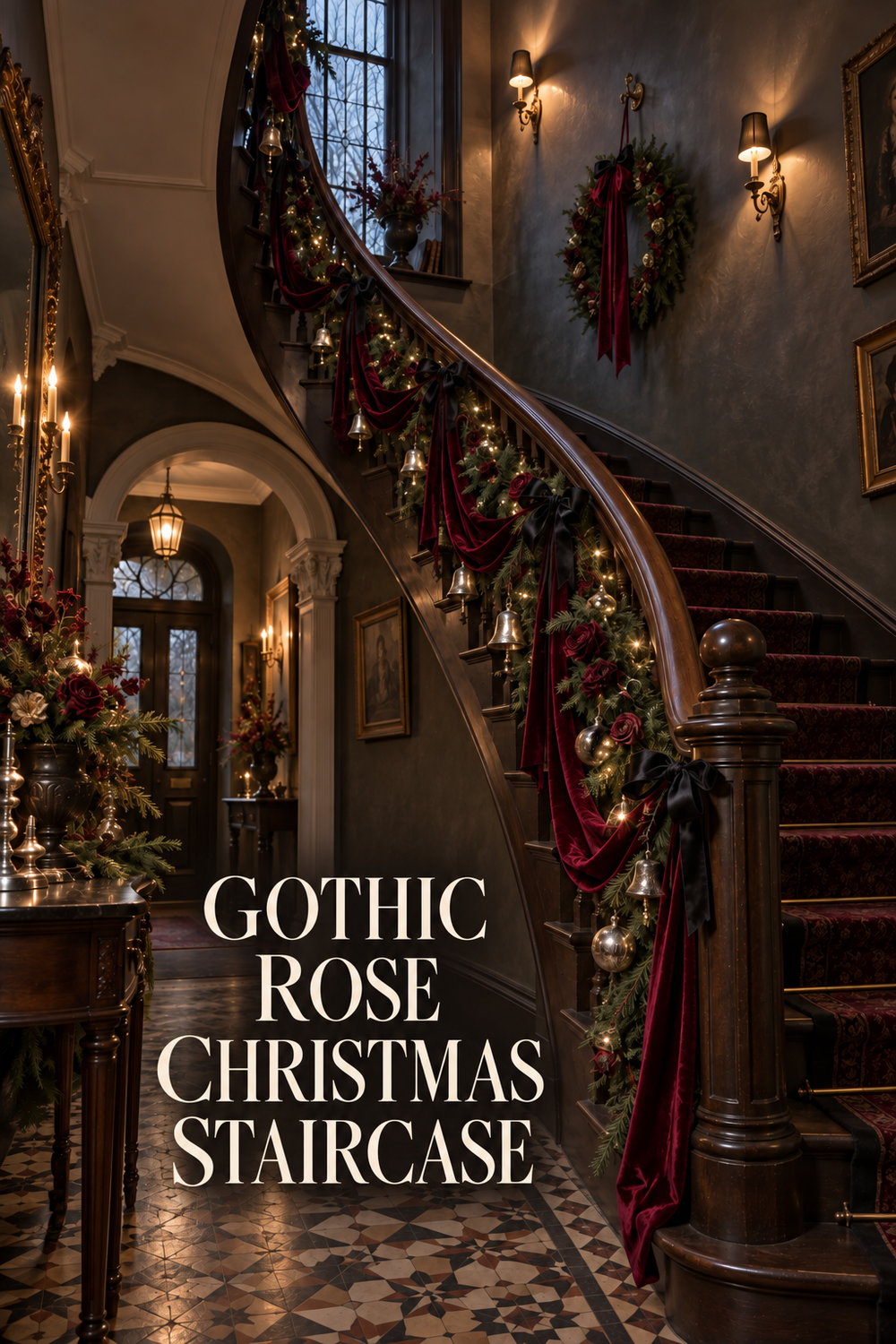
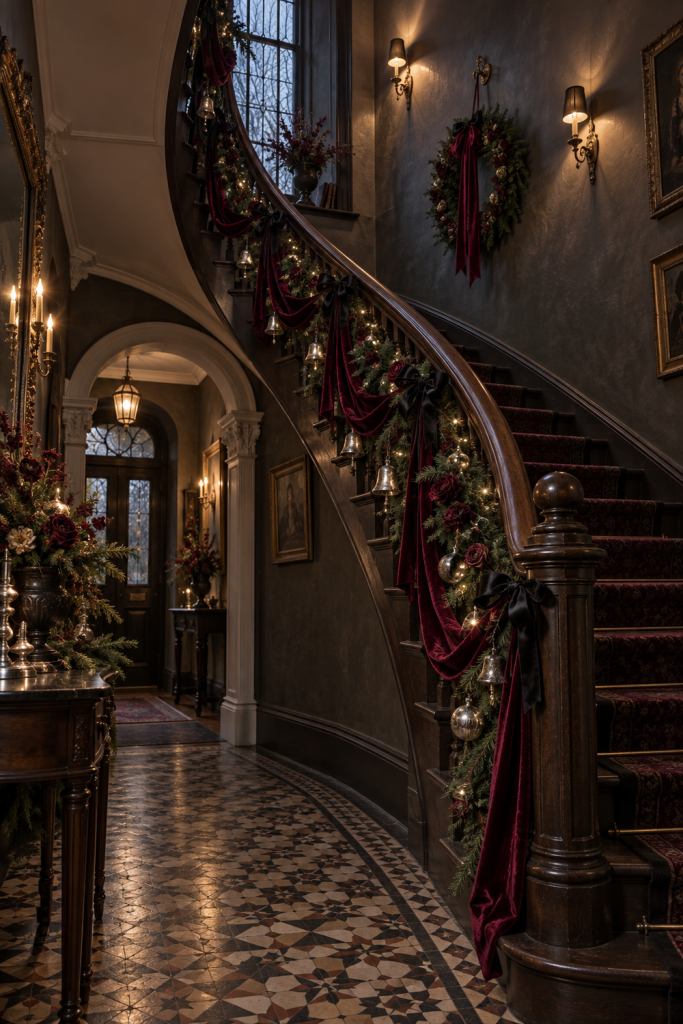
This Christmas stair hall takes its cue from deep burgundy velvet, dark roses, evergreen, and aged silver. The decorations trace the curved banister, so the architecture remains the star even with a rich palette. Warm pin lights and wall sconces keep the charcoal walls from feeling flat, while the patterned tile floor gives the scene a believable historic-house foundation.
The Sweep of the Banister Sets the Rhythm
The strongest move is not any single ornament. It is the continuous line of greenery following the stair curve from the large newel post toward the upper landing. Velvet drops interrupt that line at measured intervals, and the silver bells create smaller points of reflection. Because the decorations move with the rail, the eye reads one composition rather than many separate bows.
The visible handrail and open tread edges matter. A decorated staircase should still look usable. In a real hall, secure greenery to balusters or another suitable fixed point instead of wrapping bulky material over the gripping surface. Keep all fasteners smooth and follow the garland and light manufacturers’ instructions.
Burgundy Velvet Makes the Greenery Feel Formal
Wide velvet has enough body to form deep folds without adding numerous ornaments. The image uses long swags rather than small repeated bows, allowing the burgundy to read from across the hall. Black bows at key attachment points create a sharper boundary between the ribbon and dark wood.
I would sample one ribbon loop against the wall and banister before buying the full length. Burgundy shifts dramatically under warm lamps, and a fabric that looks red in daylight may become brown or purple at night. A slightly varied pile often looks richer than an aggressively shiny surface.
Roses and Silver Keep the Palette from Becoming Heavy
Dark roses echo the ribbon but introduce a rounded organic shape. They appear in restrained clusters, mostly near structural pauses rather than at every baluster. Silver bells and baubles supply a cool counterpoint and catch the pin lights. Their aged finish sits comfortably beside the dark wood and old-fashioned wall sconces.
The wreath on the charcoal wall repeats the same family of materials without copying the stair garland exactly. Its long burgundy tails provide a vertical line in an otherwise empty wall bay. This secondary element makes the hall feel complete while keeping the main staircase dominant.
Key Pieces to Recreate the Look
Flexible Evergreen Garland
Choose garland that bends closely around a curved rail and has enough branch tips to conceal fasteners. A mix of needle shapes appears more natural.
Wide Burgundy Velvet Ribbon
Look for ribbon that drapes in rounded folds but is not so heavy that it pulls on the greenery. Wired edges help shape bows and swags.
Deep Red Faux Roses
Matte petals and varied bloom sizes blend better with winter foliage than uniform, glossy flowers. Short stems are easier to tuck securely.
Aged Silver Bells
Use a few medium bells as punctuation rather than a bell on every drop. Check hanging loops and weight before attaching them to garland.
Warm Battery Pin Lights
A fine dark or green wire can disappear into foliage. Select a battery unit and timer suited to the location, and keep controls accessible.
Dark Satin Accent Bows
Black or near-black bows define anchor points and prevent the burgundy ribbon from becoming one uninterrupted mass.
Plan the Staircase from the Newel Post Up
Measure the decorated run along the banister rather than estimating from floor dimensions. Establish the beginning and end points, then mark a few intermediate anchors. Install the evergreen first and check that the stair remains comfortable to use before adding weight.
Shape the longest velvet swags while the ribbon is still on the roll. Let each drop vary slightly with the changing stair angle. If the hall is narrow, I would shorten the lowest tail near the newel post so it cannot trail into the walking path, even if a longer ribbon looks dramatic in a photograph.
Add lights after the garland but before flowers and ornaments. This keeps the wire buried while leaving bulbs visible. Place roses close to secure branch junctions, then hang bells where they will not strike the wall or rail during normal movement. Finish by viewing the staircase from both the front door and the upper landing.
Shop Similar Pieces
Match the Garland to Your Rail
Look for a flexible core, realistic tip density, and a length that allows gentle shaping without excessive overlap.
Choosing Velvet with Useful Structure
Wired edges are valuable for bows, while softer unwired sections create relaxed swags. Select based on the treatment you plan to repeat.
Find Bells with Secure Hanging Loops
Compare weight, opening size, finish, and loop construction. Lightweight bells are easier to distribute safely along greenery.
Select Low-Profile Battery Lights
Prioritize a compact battery case, timer function, warm color temperature, and a wire color that recedes into the garland.
Final Styling Tip
Place a small removable label on the back of each ribbon bundle as it comes down. Recording its stair position makes next year’s installation faster without forcing the swags into identical lengths.