*This post may contain affiliate links for which I earn commissions.*
This image was created with AI and is presented as decorating inspiration.
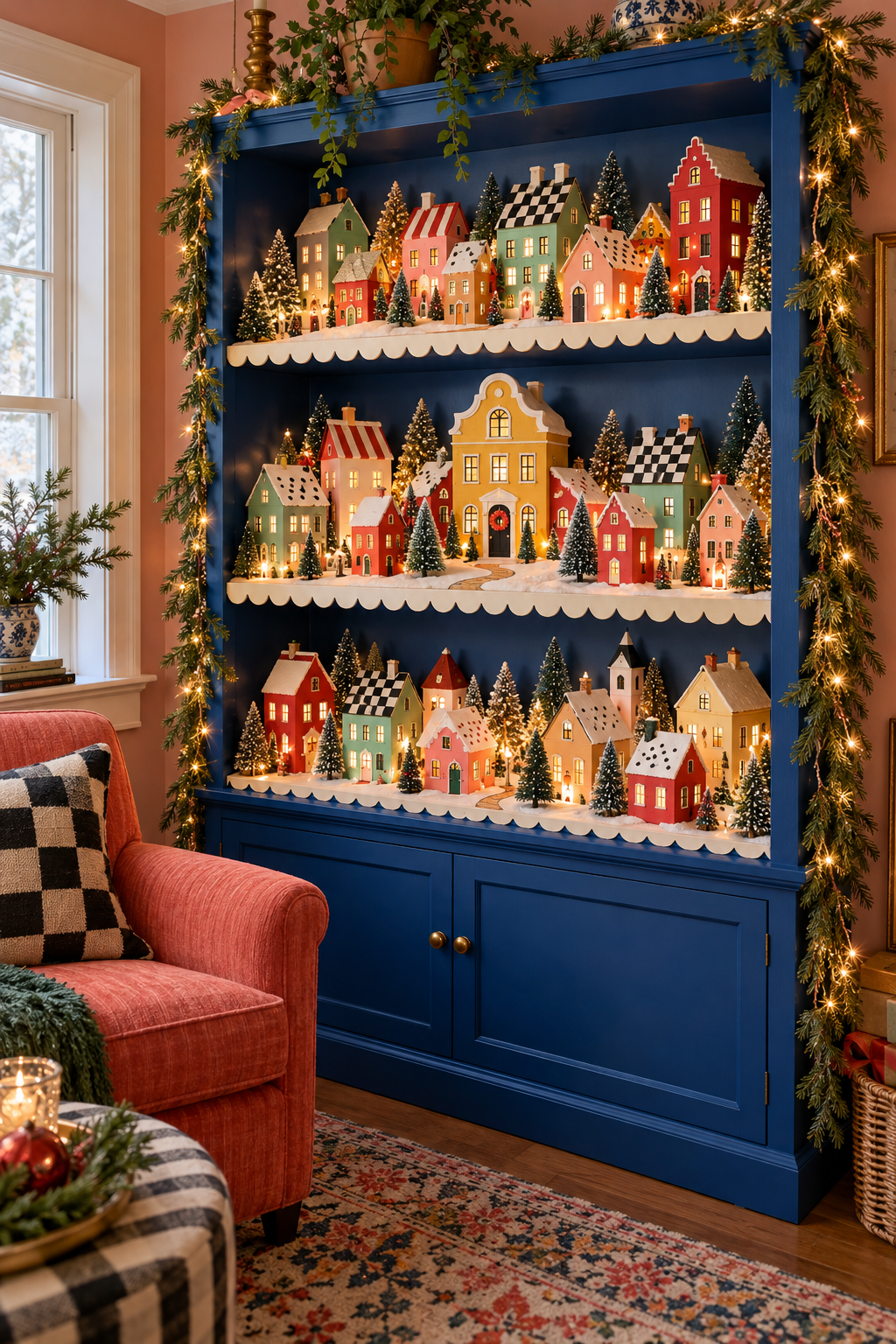
A Christmas village can occupy more than a single tabletop. In this AI-generated scene, a blue bookcase becomes a stack of little winter streets, with colorful houses, miniature trees and patterned roofs filling the open shelves. A larger yellow building gives the middle level a clear destination, while the surrounding houses keep the scene lively.
The room continues the mix with a coral chair, a checked cushion and a patterned rug. Those pieces help the display feel connected to a home, rather than set apart like a shop window. Recreating the idea begins with the cabinet and the shape of the village; the smaller details can follow gradually.
What Makes This Look Work
The blue cabinet contains the entire village
The dark blue background makes pale roofs and bright house fronts easy to see. Its repeated shelf openings also give the abundance a boundary. Without that frame, the same collection could spread across several surfaces and lose its main idea. Here, each level belongs to one larger display.
Roof patterns turn small houses into bold shapes
Black-and-cream checks, red-and-cream stripes and scattered dark dots are large enough to read on miniature roofs. Plain walls below them prevent each house from becoming a competing collection of patterns. The contrast concentrates the playful character at the roofline, where it remains visible from across the room.
A larger building creates a destination
The yellow house on the middle shelf rises above its neighbors. Smaller buildings and trees sit around it, making that level feel like a little town square. The other shelves repeat the village language without copying the exact arrangement. Warm window lights soften the graphic roofs and suggest an evening scene within the display.
Key Pieces to Recreate the Look
An open bookcase or display cabinet
Choose shelves with enough depth for buildings to stand securely behind the front edge. A colored backing is especially useful when the village contains pale roofs and small illuminated windows.
A varied group of decorative village houses
Look for a mix of tall and low silhouettes rather than a row of identical cottages. A relatively large building can anchor the middle shelf, with smaller houses distributed elsewhere.
Miniature evergreen trees
Trees fill the gaps between buildings and reinforce the winter setting. Different heights help separate neighboring roofs, but their bases need to sit flat on the shelf.
Scalloped shelf-edge trim
The cream scalloped edging in the image makes the shelf levels look like separate snowy streets. Removable paper trim can suggest the same effect without permanently altering a cabinet.
Warm decorative lighting
Illuminated house windows and small lights around the cabinet give the village depth. For a real display, use lighting intended for the chosen setting and follow its placement instructions.
A checked cushion or nearby patterned textile
One large check near the cabinet repeats the roof graphics at room scale. Use an existing chair cushion, throw or rug where possible; the display does not require replacing the seating area.
How to Style It at Home
Begin with one complete shelf
Empty the decorating area and measure its usable depth before collecting more houses. Arrange the main building first, then add a few smaller neighbors. Leave enough space between them to distinguish doors, roofs and tree silhouettes. View the arrangement from the doorway, where it will usually be seen.
If the shelf is shallow, keep the village in one row and create height through the buildings themselves. Stacking unstable boxes behind houses is a poor trade for a more elaborate scene. The front edge should remain clear enough that nothing appears ready to tip forward.
Make each level a different neighborhood
Give one shelf the tallest house, another a lower line of cottages and the third a more open grouping around trees. Repeat colors across levels so they belong together, but move the strongest roof pattern to a different position on each shelf. This avoids a rigid grid of identical displays.
A pale paper or fabric shelf liner can suggest snow. Keep it smooth beneath every base, and avoid loose material around lighting components unless their instructions allow it. Curving a simple paper path between buildings can help a shelf read as a street without adding more objects.
Limit the patterns on each building
A checked roof with a plain house front is easier to read than checks on every surface. If your existing houses are already detailed, introduce the larger pattern elsewhere, such as a removable shelf backing or a cushion. There is no need to modify a finished decorative house to match the image exactly.
Aim for a few repeated pattern families. Broad stripes and large checks can appear more than once, while dots act as a smaller contrast. Keep the busiest houses separated by quieter buildings or a tree so the roof shapes remain distinct.
Connect the display to the seating corner
Place a patterned cushion on nearby seating and repeat one house color in a throw or small accessory. Leave the chair usable and keep the floor route clear. A village that fills the cabinet already provides substantial decoration; surrounding furniture needs only a few connections to it.
Plan access to switches and battery compartments before adding the final trees. Route wires behind or along the cabinet frame where their instructions permit, without trapping them under heavy pieces.
Shop Similar Pieces
Compare the house footprints first
Check the listed base dimensions against your shelves, including space for adjacent trees. Photographs can make miniature buildings look deceptively compact. Buy around the cabinet you have, rather than assuming a coordinated collection will automatically fit.
Look for trees with steady bases
A narrow tree can bridge the gap between two roofs, but a wobbly base makes arranging difficult. Compare the stand shape and overall proportions, especially if the trees will sit on a shelf liner.
Choose lights you can service easily
Consider the power source, switch location and access to batteries. A decorative effect that requires dismantling the entire village whenever power needs attention is less convenient than a simpler setup with accessible controls.
Check how temporary trim attaches
For shelf-edge decoration, compare the trim material with the cabinet finish and the proposed attachment method. Test any removable adhesive in an inconspicuous area according to its instructions. A lightweight paper strip may be sufficient to suggest the scalloped edge.
Final Styling Tip
Take a quick photograph of each finished shelf before packing it away. The pictures make next year’s setup easier while leaving room to change one neighborhood rather than rebuild the whole village from memory.