
*This post may contain affiliate links for which I earn commissions.*
This inspiration image was created with AI.
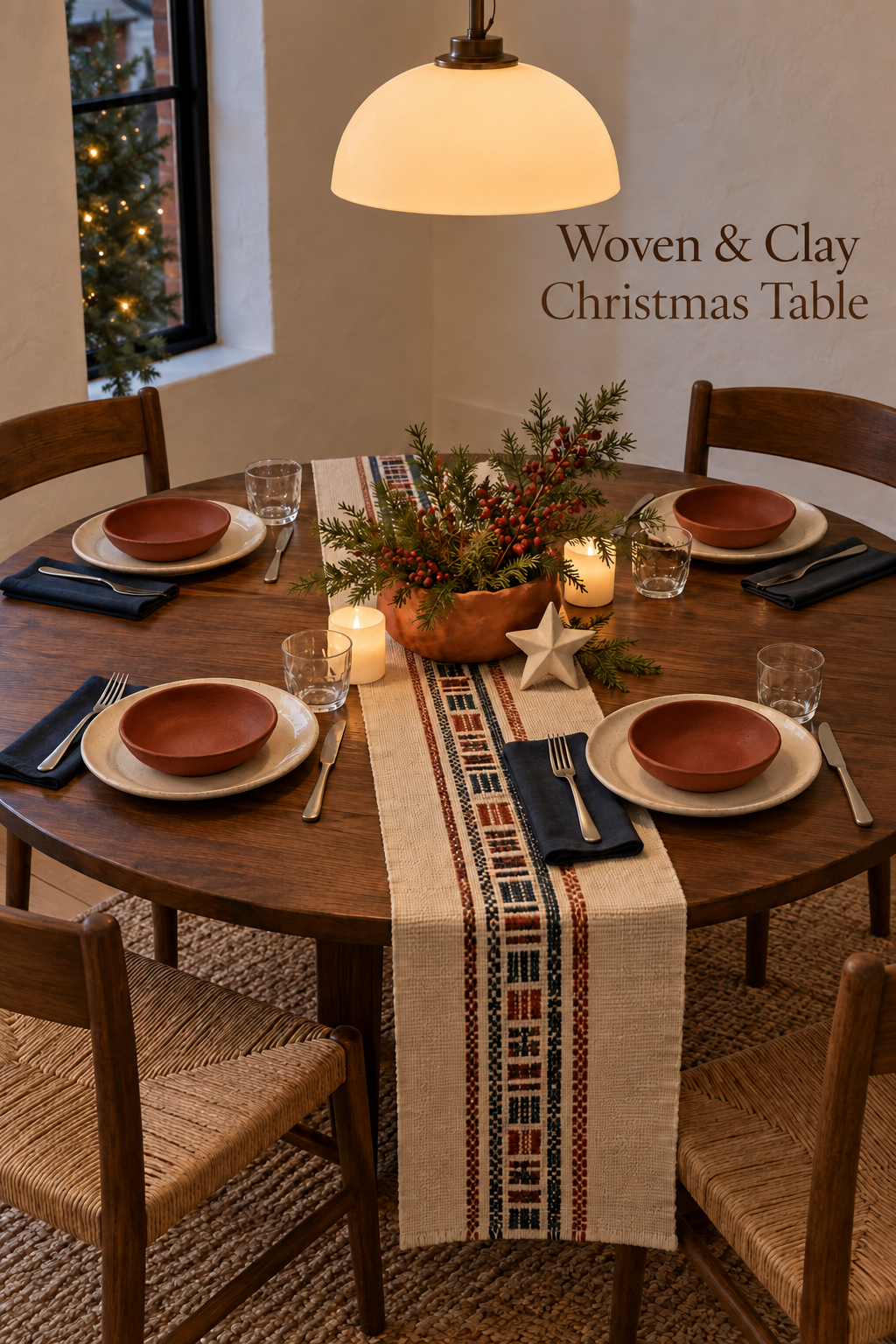
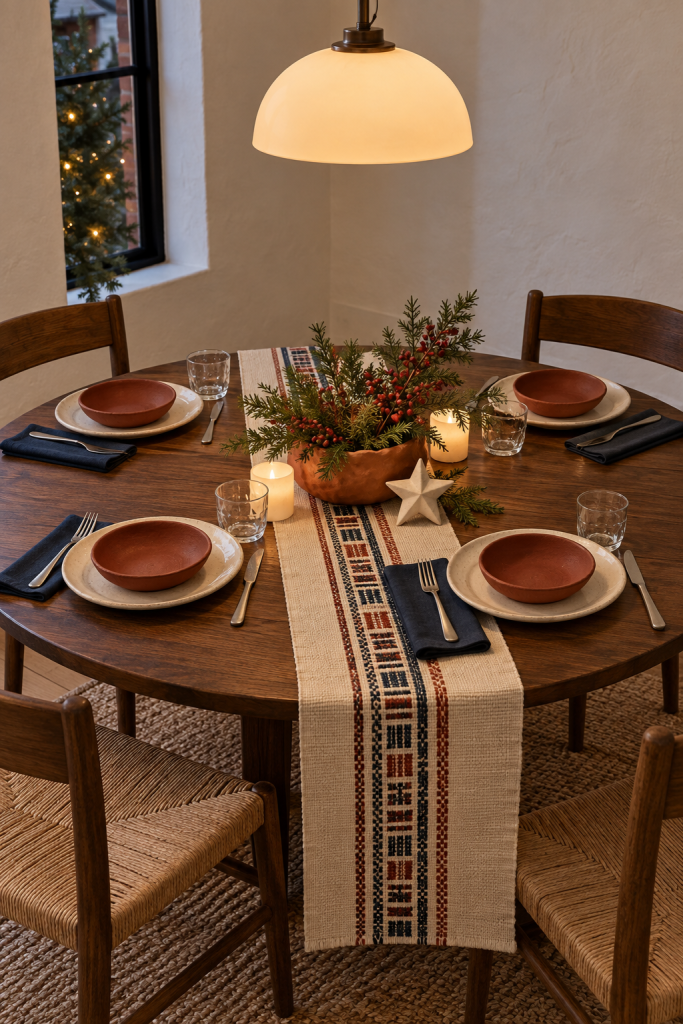
An earthy Christmas table can feel festive without a full set of holiday dishes. In this inspiration, reddish bowls sit on pale plates around a dark round table. A patterned cream runner links the settings to a low bowl of evergreen and red berries, while a pale star gives the center a recognizable Christmas detail.
The useful idea is the relationship between cloth and pottery. The runner supplies small, regular marks; the bowls answer with broad, simple curves. Recreating that balance matters more than finding the exact pattern or buying every accessory shown.
Why the Cloth and Pottery Belong Together
Narrow stripes leave the tabletop readable
The runner crosses the table instead of covering it completely. Its indigo and reddish bands concentrate the pattern in one line, leaving dark wood visible around the plates. That open surface helps each setting remain distinct. A broad, busy tablecloth would change the mood and compete with the ceramic shapes.
Rounded dishes soften the woven geometry
The shallow bowls have warm reddish interiors and gently curved edges, while the pale plates give them a lighter outline. Their simple shapes keep the patterned textile from feeling overly graphic. The centerpiece repeats the bowl silhouette in a less regular form, making the center related to the dinnerware without requiring a matched set.
Small pale accents interrupt the dark center
Cream candle forms and a pale star stand out beside the greenery. They create separate points of brightness beneath the large pendant rather than one crowded cluster. The evergreen branches spread outward, so the table feels seasonal without needing a tall arrangement between the diners.
The Pieces That Carry This Supper Setting
A cream runner with restrained geometric bands
Choose a textile with visible weave and a limited pattern area. Cream should occupy enough of the cloth to separate the colored bands and keep the centerpiece legible.
Reddish shallow serving bowls
Warm clay-colored bowls establish the earthy palette at every seat. Look for comfortable rims and practical depth for the meal you plan to serve, rather than decorative vessels that only resemble dinnerware.
Pale everyday dinner plates
A cream or softly speckled plate provides a clear border around the bowl. Existing plain dishes can do this job; elaborate embossed edges would introduce another competing pattern.
Indigo cloth napkins
Dark blue napkins extend the runner’s smaller blue marks into larger areas. A simple rectangular fold suits the relaxed setting and makes the cloth easy for guests to pick up.
A low irregular centerpiece bowl
The central vessel needs enough breadth to contain the stems without covering the runner completely. A matte warm finish relates to the place settings while a slightly uneven outline prevents a rigid matched-set effect.
Evergreen stems with berry accents
Loose branching greenery makes the most immediate seasonal connection. A small amount of red berry color is sufficient because the dishes already provide a strong warm note.
A pale star and battery candle lights
These small accents clarify the Christmas theme at the center. Favor freestanding shapes with stable bases, and use battery lights when greenery and textiles share the tabletop.
Arrange the Table Around the Meal
Set out the guest positions before the runner
Place a plate at each occupied chair and allow comfortable elbow room. On a smaller round table, reduce the number of seats rather than compressing the settings. Add the runner only after you can see the central area that remains available.
Keep its hanging ends out of chair seats. A shorter runner is preferable to a long textile that guests pull when sitting down, particularly where the table also serves as an everyday dining spot.
Decide whether each bowl has a dining purpose
The image suggests a bowl-led supper setting, which works for soup, stew, or another suitable course. For a meal served entirely on plates, leave the bowls off until needed. This keeps the ceramic palette useful rather than turning each place into a decorative stack that must be dismantled before eating.
Put the required fork to the left and knife to the right, blade inward. A drinking glass belongs above and to the right of the plate. Extra cutlery and stemware can remain away from the table unless the menu calls for them.
Contain the branches in a liftable center
Build the greenery inside the low vessel, turning the stems so their tips remain within the space between settings. Test sightlines from a seated position. Shorten or turn any branch that covers another person’s face or catches a sleeve when a glass is lifted.
Keep loose foliage and decorative berries away from plates and food. If fresh stems need water, use a watertight inner container instead of assuming a decorative clay bowl will hold it. The entire arrangement should lift away easily when serving dishes arrive.
Make the evening light comfortable
Use the pendant or normal dining light to illuminate the food, with battery candles providing a softer accent. Very dim lighting may hide the blue napkins and flatten the runner pattern. Try the setting after sunset before deciding that more candles are needed.
Leave light switches and battery controls reachable. Decorations should not require disassembling the center every time the room changes from supper to cleanup.
Buying Notes for a Similar Table
Check runner width against the open center
Compare the textile’s finished dimensions with your actual table and plate layout. A narrow patterned band can work better than a wide runner on a compact round table. Check laundering instructions and whether the weave catches easily on cutlery.
Choose dinnerware you can serve from
Confirm that bowls and plates are intended for food use. Look at interior depth, stacking, and the seller’s care guidance rather than judging solely by a styled photograph. Clay color does not establish the material or its suitability for a dishwasher.
Look inside the centerpiece vessel
Photographs of its opening and base are more useful than a distant room shot. Check stability and whether a removable water container will fit if fresh greenery is planned. Decorative surface texture should not make the vessel difficult to lift.
Compare blue napkins in ordinary light
Seller images may make navy look black or vivid cobalt. Prefer a subdued dark blue that relates to the runner, and consider shrinkage and color-care instructions when choosing reusable cloth.
Final Styling Tip
Before guests arrive, place a clean tray on a nearby counter for the centerpiece and star. Their temporary landing spot makes clearing room for shared dishes a quick movement instead of a search for somewhere to put delicate decorations.