
*This post may contain affiliate links for which I earn commissions.*
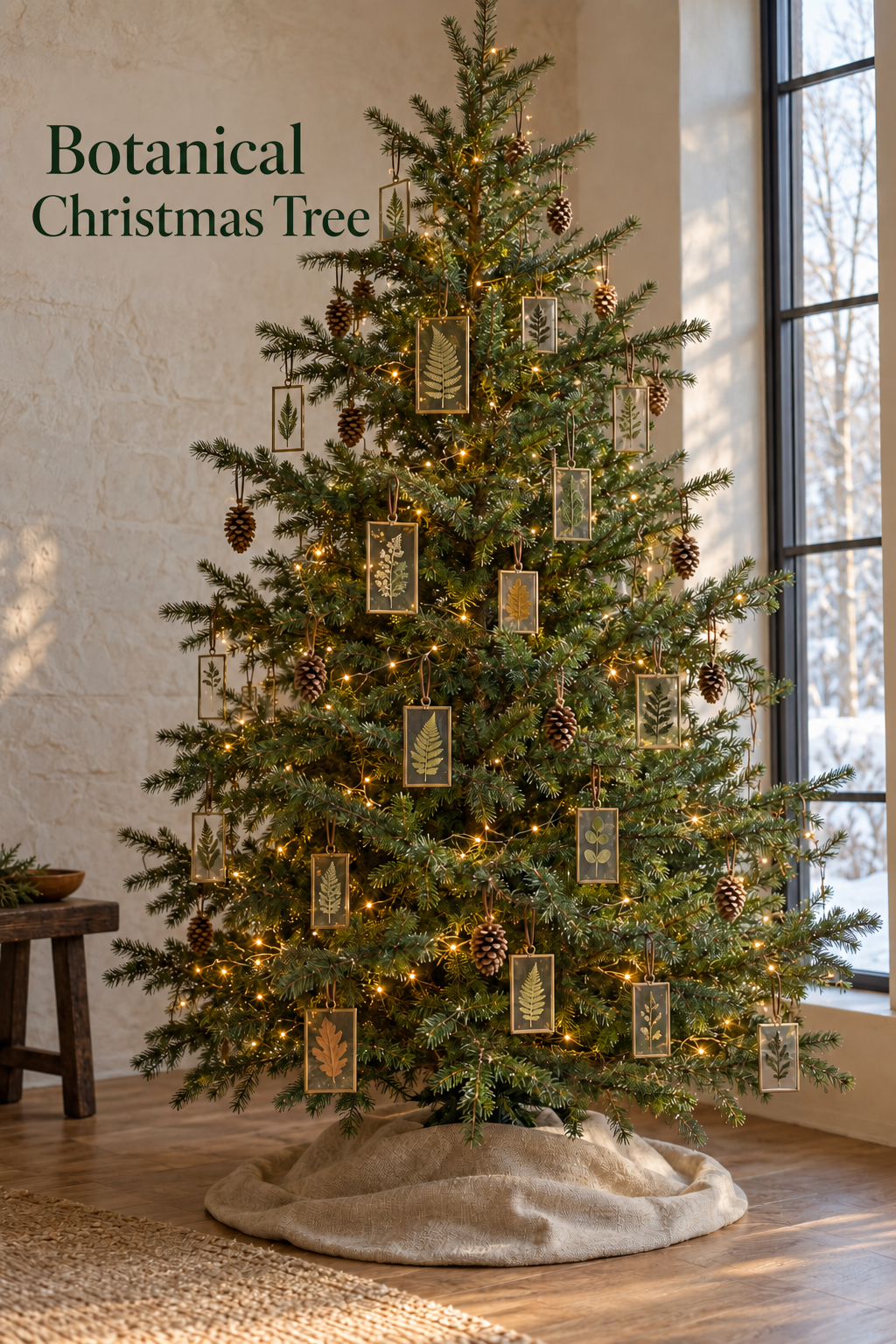
Image created with AI. This image serves as visual inspiration for the decorating ideas below.
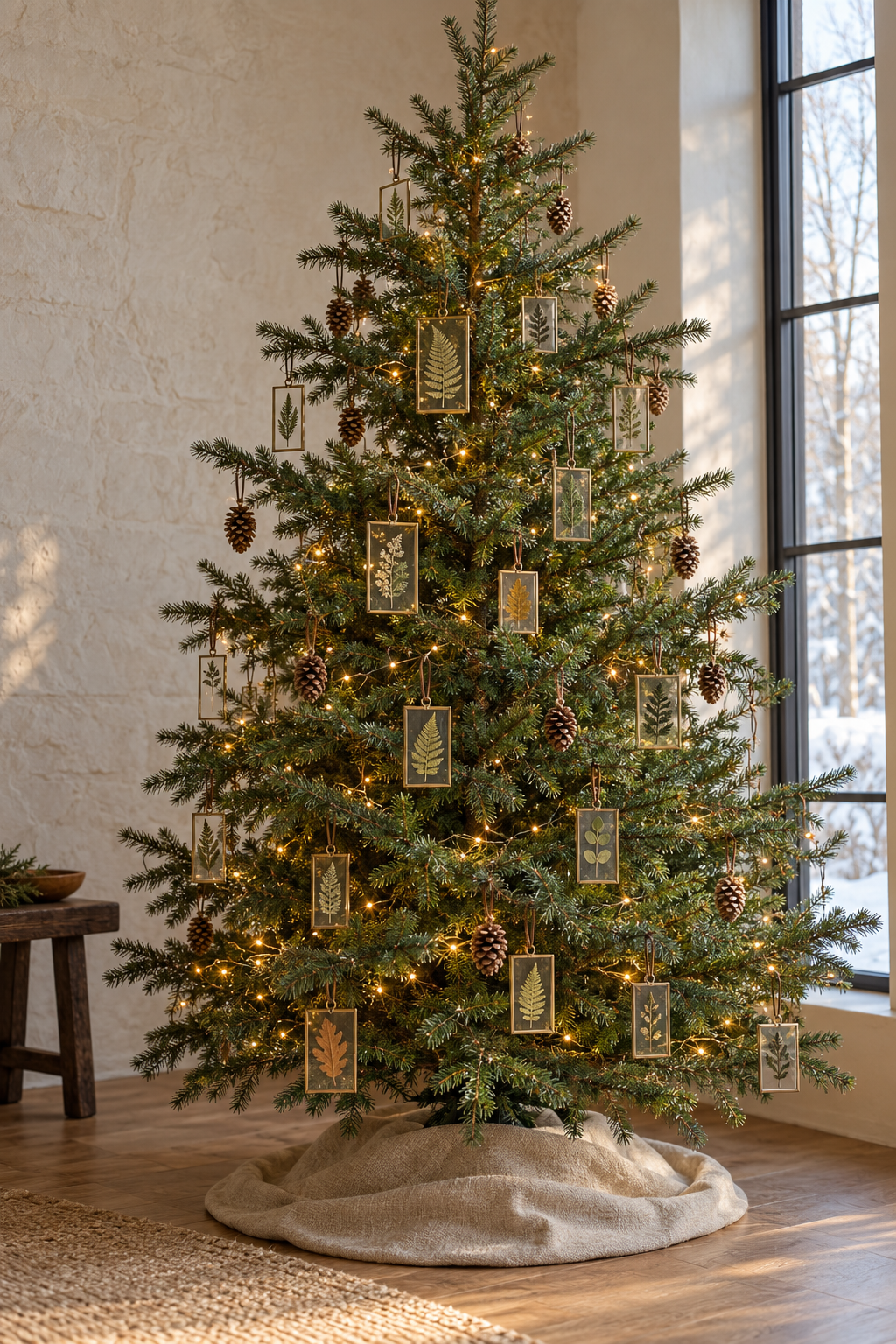
Small rectangular botanical frames make this Christmas tree feel like a collection gathered from the woods. Pale fern and leaf silhouettes sit against the evergreen, while hanging pinecones continue the natural theme. Warm lights provide the festive signal without a ribbon cascade or a large topper.
This is a useful direction for anyone who prefers ornaments with clear shapes and a quieter palette. The goal is to let the foliage remain part of the decoration, with enough space around the frames to notice what each one contains.
What Makes This Look Work
Flat ornaments reveal the branches behind them
The narrow frames have relatively little depth, so they interrupt the foliage less than bulky clusters would. Their transparent-looking sections let parts of the tree remain visible. A flat botanical ornament can therefore be prominent without turning the tree into a solid wall of decorations.
Fern shapes and cones provide different outlines
The framed leaves introduce fine branching patterns within straight edges. Pinecones hang as rounded, textured forms outside those rectangles. That difference keeps a restrained ornament collection from looking monotonous, even though nearly everything stays within green, brown and warm neutral tones.
The natural peak keeps the tree silhouette simple
The upper leader remains undecorated, allowing the outline to narrow gradually. Lower down, the plain gathered fabric at the base softens the stand area without adding a second display. The tree itself remains the largest shape in the room.
Key Pieces to Recreate the Look
An evergreen with accessible branches
Look for a tree whose branches can be seen between the ornaments. Open spacing makes it easier to position flat frames at different depths and gives their leaf silhouettes a clear background.
Lightweight botanical frame ornaments
Small hanging frames or ready-made leaf ornaments establish the specimen theme. Check that each piece is intended for hanging decoration; a heavy tabletop glass frame may be unsuitable for a tree branch.
Pinecone ornaments
Cones supply texture without introducing another bright color. Choose pieces with reliable hanging loops, and avoid a set so large that it bends the finer outer branches.
Warm white tree lights
The small points of light connect the botanical collection to Christmas. Fine wiring can recede among the needles, leaving the rectangular ornament edges easier to see.
Simple ornament loops or hooks
Secure attachments matter with flat pieces that may twist when hung. Use loops or hooks suited to the ornament and tree, keeping them discreet enough that the foliage remains the focus.
A neutral tree skirt
A plain oatmeal or tan skirt completes the lower area. Soft folds echo the natural materials without competing with the detailed ornaments overhead.
How to Style It at Home
Begin with the branch structure you have
Set the tree securely and check the room’s walking routes before decorating. If an artificial tree has adjustable tips, shape them according to its instructions so the branch layers have depth rather than lying in one flat plane.
Choose a size that leaves clearance from the ceiling and nearby furniture. In a smaller room, a narrower tree can support the same specimen idea; you do not need to copy the full spread of this inspiration image.
Put the lights in place before the frames
Follow the light manufacturer’s installation guidance and select lights appropriate to your tree and location. Arrange the strand through the branch layers rather than pulling it taut across the outer edge. Step back with the lights switched on to find any overly bright clusters.
Keep the frames away from bulbs that could touch their materials, and follow all clearance guidance supplied with the lights. The image’s warm appearance does not require extra strands if one appropriate set provides an even glow.
Give each botanical outline an uncluttered background
Hang a few frames first, using larger open spaces for the strongest leaf silhouettes. A frame directly in front of a dense tangle of needles may be harder to read than one over a darker gap.
Turn a piece slightly if it reflects the window so strongly that its contents disappear. Do not try to make every frame face exactly the same direction; small changes suit the irregular branch structure and help the collection feel placed by hand.
Use cones to connect the rectangular pieces
Add pinecones between the frames at varying heights, rather than lining them into a rigid band. They should support the main ornament family, so leave some branches bare.
Check each attachment after placing it. If a branch droops or an ornament swings into a neighboring piece, move it closer to a stronger support point or replace it with something lighter. The frame’s apparent size is less useful than its actual weight when deciding where it can hang.
Finish at the base without hiding a problem
Arrange the tree skirt loosely after checking that the stand is stable. If you use a fresh tree, keep its water reservoir accessible and follow the seller’s care instructions.
Leave cables and controls available for safe operation rather than covering them with decorative folds. A clear base also makes it easier to reach lower branches if an ornament needs adjusting later.
Shop Similar Pieces
Read the hanging-frame specification carefully
Search for miniature hanging frames designed as ornaments, then compare the material, closure and weight. A decorative glass look can also be achieved with lighter transparent materials. Confirm that a hanging loop is included rather than assuming a picture frame can be suspended.
Compare tree photos with the branches in view
Listing photographs showing a completely dressed tree make openness difficult to judge. Look for undecorated views and close-ups of the branch structure. Consider whether the spaces between branches can accommodate your flat ornaments without forcing them outward.
Choose cones with durable attachment points
For purchased cone ornaments, examine how the loop joins the cone and whether pieces vary naturally in size. If you already own suitable ornaments, use those first; buying another matching set is unnecessary when the supporting texture is already present.
Check the light controls and wire color
A strand’s visible wire can change the look of an open tree. Dark or green wiring may recede more easily into foliage than a contrasting cable. Compare power source, indoor suitability and controller placement against your actual room before choosing a set.
Final Styling Tip
Store the flat botanical ornaments individually wrapped or divided after the holiday. Keeping their fronts from rubbing against cone scales helps preserve the clear surfaces that make the leaves readable when you unpack them next year.